
Featured Research
Macroeconomic Insights: Turnleaf’s March Inflation Path and Where Bond Yields Landed in September 2026
With September inflation data now arriving, we can compare the realised outcomes with forecasts made at the end of March, a few weeks into the conflict with Iran. Our forecasts had already moved higher with energy prices, providing an early view of where inflation...
Macroeconomic Insights: Turnleaf’s March Inflation Path and Where Bond Yields Landed in September 2026
With September inflation data now arriving, we can compare the realised outcomes with forecasts made at the end of March, a few weeks into the conflict with Iran. Our forecasts had already moved higher with energy prices, providing an early view of where inflation could sit six months later.
Seven economies have reported so far. Across them, our end-March forecasts sit a median 0.40 percentage points from the September print. A similar ordering is visible in bond markets, where the countries we ranked higher for September inflation in March generally now sit at higher 10-year yields.
September is tracking our March path
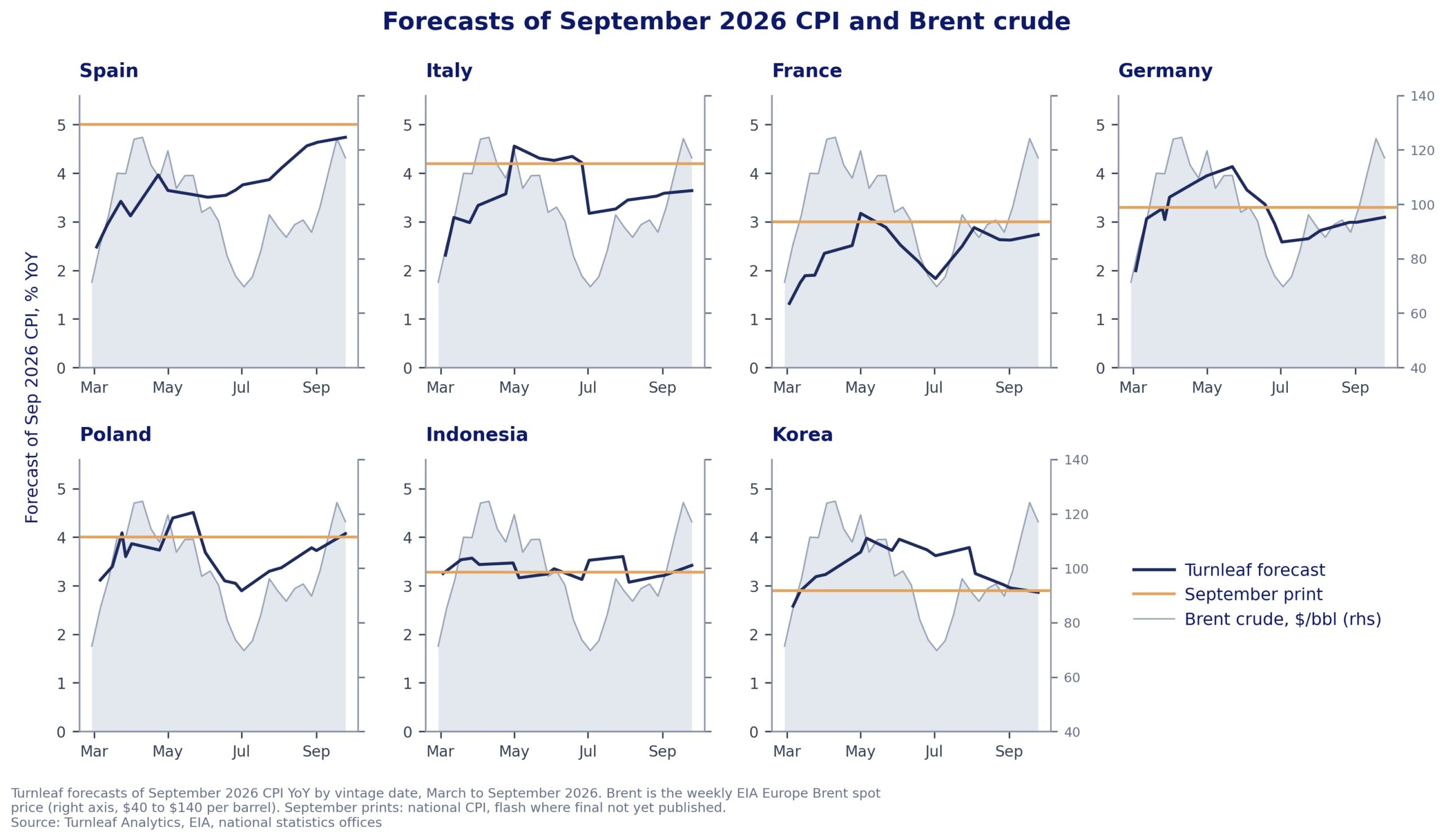
Figure 1 shows how our forecasts adjusted as the shock developed. They rose with Brent in the first weeks of the conflict, moved lower as oil retraced, then rose again as energy prices strengthened into September. Inflation in Spain, Italy and France ultimately came in above our March forecasts as the energy shock intensified again over the summer. In South Korea, a fuel price cap limited pass-through, and our forecast moved back towards the eventual print by September.
Figure 1. Turnleaf forecasts of September 2026 CPI by vintage date, March to September 2026, against the September print and Brent crude.
The rest of our coverage has yet to report September CPI. August provides an interim check, although it compares our September forecasts with an earlier inflation print. Across 31 economies excluding Turkey and Egypt, the median gap between our end-March September forecast and August inflation is 0.50 percentage points.
The inflation split is also visible in bond yields
The United States shows how inflation expectations and bond yields moved over the same period. At the end of March, we forecast September inflation at 3.72%, while market-implied pricing stood at 3.13%. By August, headline CPI had reached 3.4%. By 30 September, the market-implied estimate for September had risen to 3.66%, close to our latest nowcast of 3.69% and to the path we had forecast in March.
Bond yields repriced alongside that shift, although not uniformly. The US 10-year Treasury yield rose from 4.30% at the end of March to 5.17% on 25 September, while the 10-year Bund reached 3.62%. Yields moved less in Switzerland and Malaysia, while the Chinese 10-year yield fell.
Figure 2 puts that divergence in a cross-country context. Across a core sample of 25 markets, countries we expected in March to run hotter generally now sit at higher 10-year yields. The third-highest inflation market in our March ranking yields 3.3 percentage points more than the third-lowest. The comparison captures where yields had settled by late September, not how far each market had moved since March.
Figure 2. Turnleaf end-March 2026 forecast of September 2026 CPI YoY against 10-year government yields on 25 September 2026.
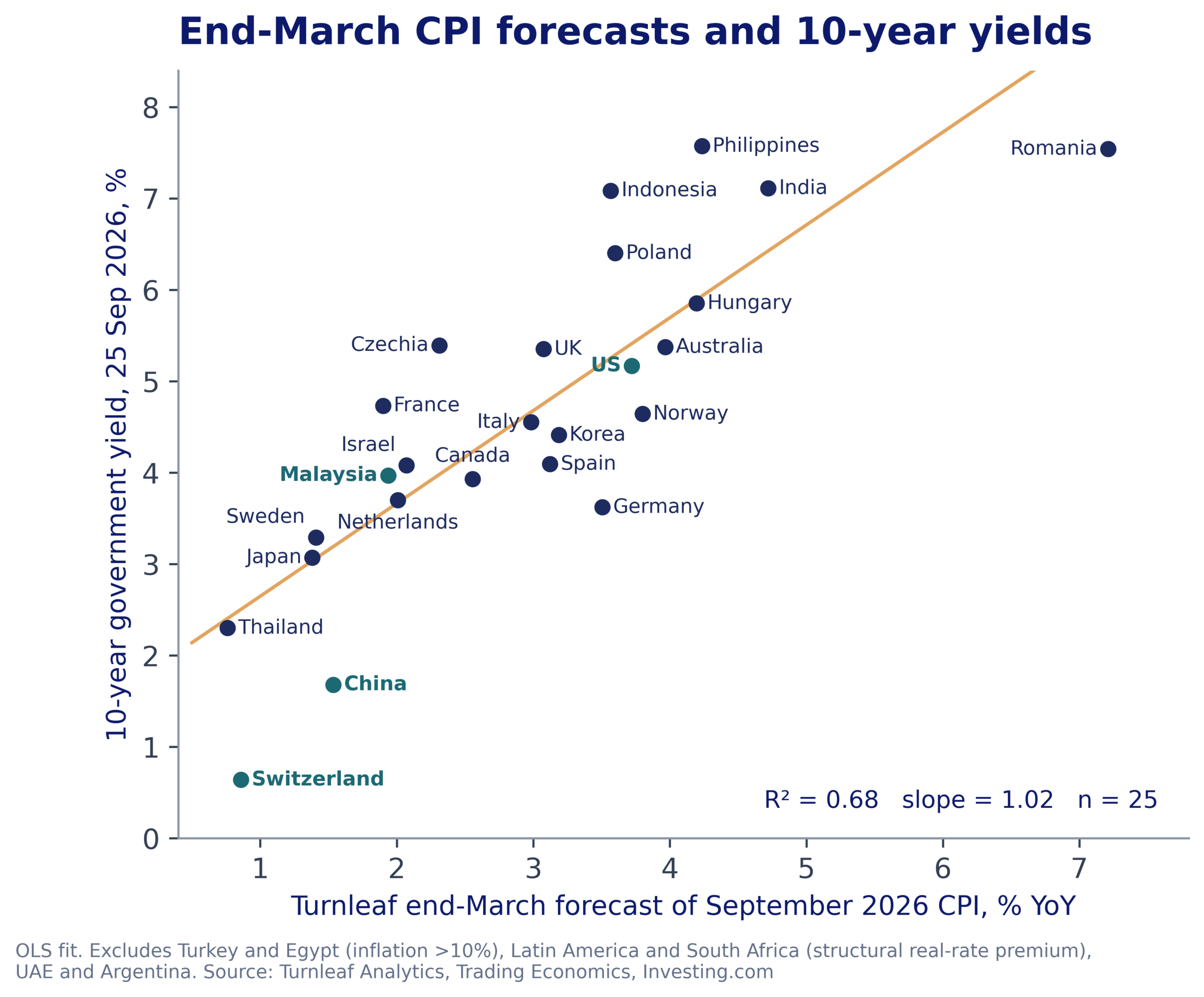
At the low-inflation end, Switzerland, China and Malaysia remain among the lower-yielding markets in the sample. The Swiss 10-year sits at 0.64%, China’s at 1.68% and Malaysia’s at 3.97%, below Indonesia and the Philippines. Inflation in all three has also remained relatively contained.
The US path from here
To read the rest, visit our latest Substack article, here.
Research Archive
Macroeconomic Insights: Mexico CPI Divergence and the IEPS Fuel Stimulus, July 2026
Since early March, the US-Iran conflict has disrupted Gulf oil supply, closing the Strait of Hormuz to commercial traffic and taking Brent crude from roughly USD 70 in January to...
Macroeconomic Insights: The Red Sea Escalation, the Tariff Regime Reset and the U.S. Inflation Path
The new round of United States tariffs will not add materially to inflation. The 10% Section 122 surcharge lapses today, 24 July 2026, and the Office of the United States Trade...
Macroeconomic Insights: UK Policy Package and the Underlying Inflation Picture
UK CPI printed at 2.6% YoY in June 2026, but the composition of that print sits uncomfortably against a broader policy package now working its way through the price level....
Macroeconomic Insights: The Oil Shock Could Spread Beyond Hormuz
The oil shock has entered a more complicated phase. Since late February, when the US and Iran conflict began, shipping through the Strait of Hormuz has been severely restricted,...
Imperial College Hedge Fund Conference 2026
I’ve been to many finance conferences over the years, very often they are either focused towards academia or towards practitioners. The Imperial College hedge fund conference has...
Macroeconomic Insights: US CPI – The Strange Swing in U.S. Cell Service Prices
The wireless telephone services component of US CPI has been behaving strangely over the past year. The recent behaviour is really two things stacked on top of a long structural...
Macroeconomic Insights: Colombia CPI — Inflation After the Election
De la Espriella's narrow runoff win prompted the market to price a more orthodox, pro-business stance. That meant a stronger peso and lower risk premia, with a chance of...
Macroeconomic Insights: FIFA World Cup and Inflation, Where Anything Can Happen
Every time I watch the FIFA World Cup, there's always something that surprises me. I didn't expect Japan to score against Brazil in the first half, nor did I expect Cape Verde to...
Macroeconomic Insights: El Niño and the Inflation Outlook for the Year Ahead
A developing El Niño is becoming an important force in the inflation outlook over the next year. By shifting global rainfall patterns, it can bring drought to some regions and...
ECONDAT 2026 at Banque de France
I've been to Paris many times over the years. Each time I’ve visited I’m always surprised at how much I still have to learn about the City of Light. I always say I’ll learn about...
Macroeconomic Insights: What Comes Up, Must Come Down?
Today, the United States and Iran have signed a deal ending the war. Among the many points outlined in the agreement, the normalization of trade through the Strait of Hormuz,...
Neudata Summer Data Summit 2026
“Be obsessed with data”, was probably the best line I heard all day at the recent Neudata data summit in New York. I went to my first Neudata event close to a decade ago in...
Macroeconomic Insights: Where Will the Oil Shock Hit Next?
Turnleaf reads the current inflation data as a test of duration. Fuel prices have lifted headline CPI, while core has stayed contained because energy prices have not remained...
Macroeconomic Insights: The Hidden Cost of the Iran War
Over the past several months, Turnleaf has examined the inflationary impact of the Iran conflict across fuel, food and airline prices, as well as the intermediary inputs that...
Macroeconomic Insights: How the Hormuz Closure is Moving Airfares
The Strait of Hormuz closure is best understood as an inflation shock transmitted through energy logistics. The relevant issue is that usable supply has become harder to move and...