
Whenever I travel somewhere, I like to read books about the place I’m visiting. It helps in way to provide some context for me. Over the years I’ve been to Portugal many times, and I’ve read numerous books about the country, ranging from José Saramago’s Journey to Portugal to Fernando Pessoa’s Book of Disquiet – which is one of the most fascinating and unusual books, that I’ve ever read, and one that I’m keen to read again. In 2023, I was in Lisbon for LxMLS, a machine learning summer school, which I found incredibly useful: there is something to be said for sitting in a classroom away from the office to go through concepts from a theorical perspective. LLMs were all the rage then, and I guess they still are, although, one piece advice from one of our lecturers was that’s it’s ok to research other areas of machine learning. I still believe that’s the case, and indeed, we take that idea to heart at Turnleaf Analytics, where our main focus is time series forecasting using machine learning, a vertical AI application.
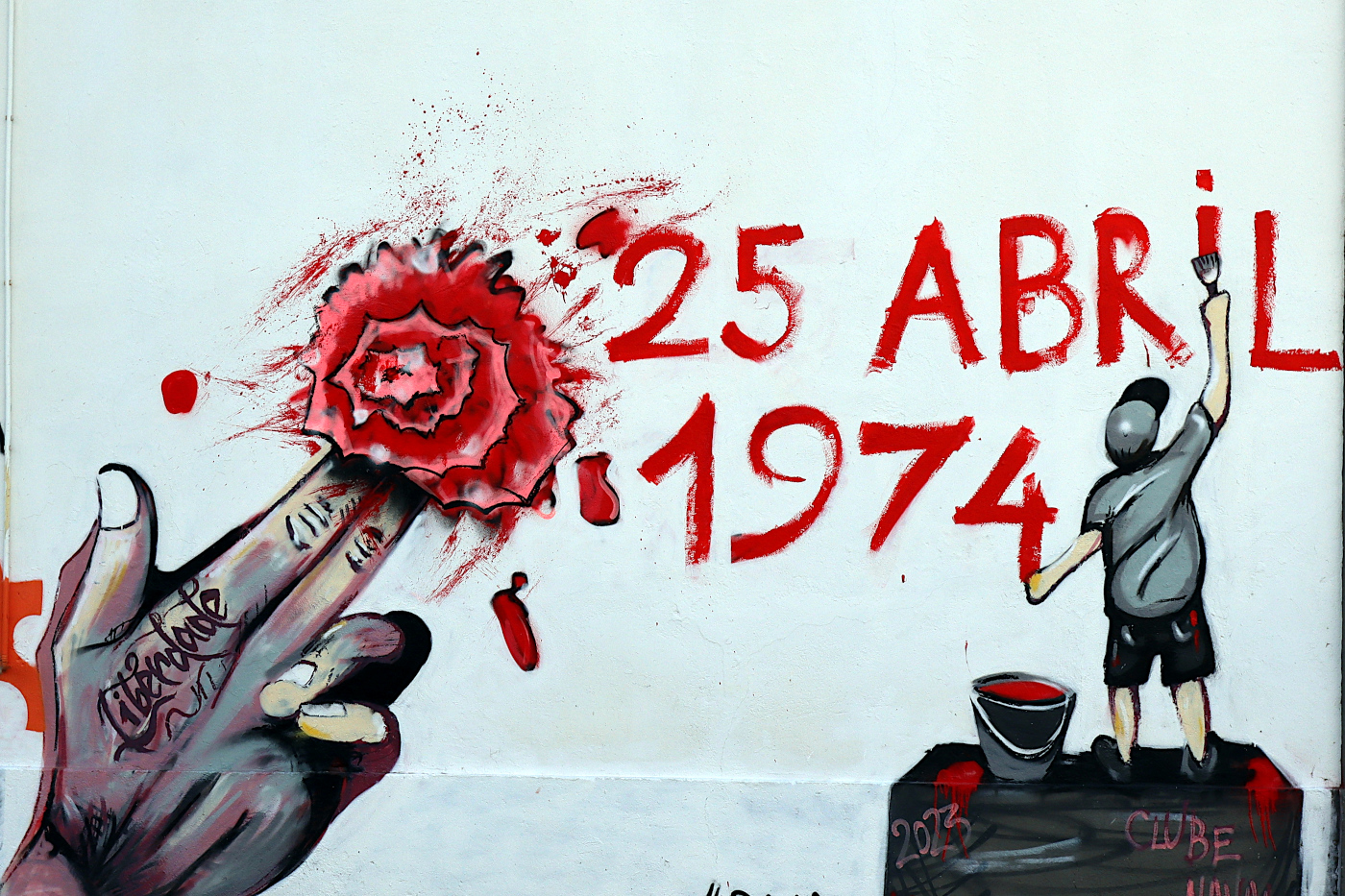
I always like to run along the Tagus river whenever I’m in Lisbon. There are many murals in Lisbon, and during one of these runs on that visit, I stumbled across a certain mural near the river, with the date “25 Abril 1974”, which I later found out is a national holiday in Portugal, celebrating the Carnation Revolution. I have to admit I didn’t know much about modern Portuguese history at the time, because most of the books I had read mostly covered earlier periods of Portuguese history or were simply about other topics, so it got me thinking that I should read more about it. Since then I’ve been reading numerous books about modern Portuguese history, including The Carnation Revolution: The Day Portugal’s Dictatorship Fell by Alex Fernandes, which I’m close to finishing at present, and is a thrilling hour by hour account of the events.
It explains how the revolution was literally kicked off, when one of the signals was sent through the playing of the 1974 Portuguese Eurovision entry “E Depois de Adeus” (And After the Farewell – on YouTube here if you’re interested in hearing this Frank Sinatra like track) by Paulo Carvalho, and the words introducing the song “It’s five to eleven”. Whilst the song never won the contest (a certain Swedish group called Abba won that year), it did literally start a revolution.
It is interesting how every book I’ve about what are the same series of events (the Carnation Revolution and the decades preceding), tell very different stories: despite the fact they are over fifty years ago, the biases still show. It is inescapable how the biases come out not so much in what they mention, but also in what they tend to gloss over or simply leave out. Whether it’s a narrative or a model, it’s the information or data that is missing that can have the most impact.
If we fast forward to the present day, the narrative about events happening in real-time is just as prone to bias as those from history. Traders in financial markets need to have unbiased information to make decisions. It’s the reason, traders pay for real-time news from sources like Bloomberg News or newspapers like the Financial Times: fact based reporting has a premium in the sea of opinion and bias, in particular on social media, which has a habit of drowning out everything. This is particularly relevant at difficult times like the present war in the Middle East: indeed “in war, truth is the first casualty” is a quotation we have all heard. As an aside, the ancient Greek dramatist Aeschylus was said to be the origin of this, although a quick Google search suggested other potential sources, including Samuel Johnson and more recently US Senator Hiram Johnson.
If we look more broadly at economic commentary, trying to strip away bias from a narrative difficult. We all know the permabear, who mysteriously flips their viewpoint when their party is in power, or the economist who is forever a hawk, regardless of whatever inflation is doing. Trying to make economic forecasts without bias is difficult. At Turnleaf Analytics, by employing a data driven approach and curating a thoroughly comprehensive dataset to describe the economy, we can strip away the bias and let the data speak. Of course there is an element in discretion is curating the dataset, and also in terms of putting together the forecast in a model, and any final tweaks. However, I’d argue that there is far more bias in having a view and then constructing a forecast around it. Furthermore, given how fast moving the situation at present, a data driven approach allows to quickly update a data driven forecast to be as fresh as possible. An opinion based view tends to be more static and more difficult to adjust.
So next time, you visit Lisbon, if you’re running along the Tagus, maybe take a step back and see if you can find the Carnation Revolution mural.