
Featured Research
Macroeconomic Insights: Where Are Airfares Headed?
US airline fares rose 2.7% in August on a seasonally adjusted basis and were 23.4% higher than a year earlier before adjustment. The increase was one of the services components behind a 0.3% MoM core CPI print, above the 0.2% consensus, and strengthened the case for a...
Macroeconomic Insights: Where Are Airfares Headed?
US airline fares rose 2.7% in August on a seasonally adjusted basis and were 23.4% higher than a year earlier before adjustment. The increase was one of the services components behind a 0.3% MoM core CPI print, above the 0.2% consensus, and strengthened the case for a Federal Reserve hike. It was also the eighth consecutive monthly increase in the seasonally adjusted airfare series, which has risen 21% since December.
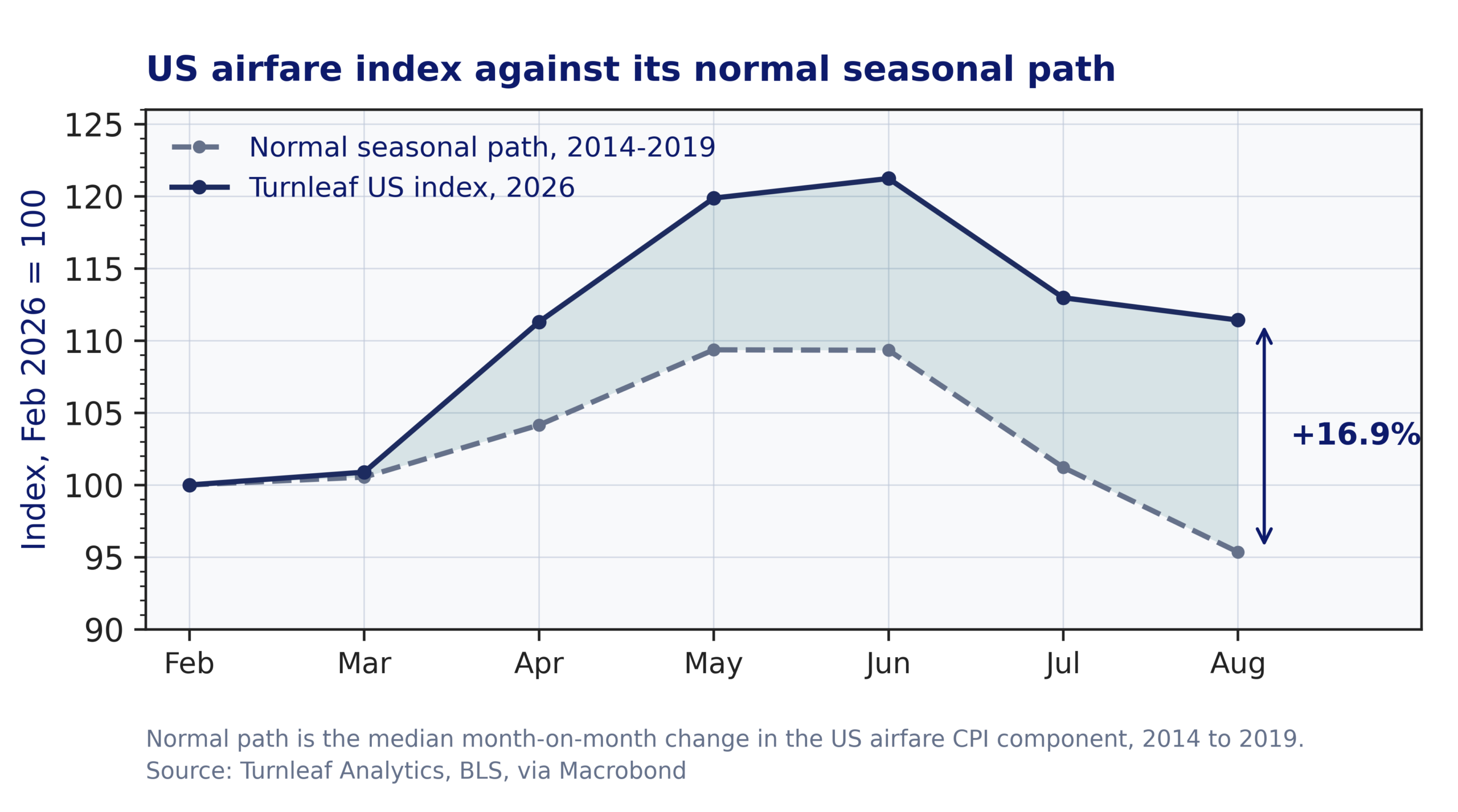
Our daily local-market airfare indices show what produced that print. Airfares have one of the strongest seasonal patterns in the CPI basket. US fares normally fall by around 13% between June and August, but our US index fell by just 4% this year. In other words, fares declined, but by less than a third of their usual summer drop. That left them further above their normal seasonal path in August than they had been in June, a widening gap that appeared in the BLS data as a 2.7% seasonally adjusted increase.
The same data show why the level of airfares alone carries so little information this year. Our US index peaked in June and has drifted lower since, so looking only at the raw level would suggest that the pressure was fading. Relative to a normal year, however, the opposite has happened. The official airfare series provide decades of history against which to estimate that normal seasonal path and compare 2026 with it. On that basis, US fares are running 16.9% above their normal February-to-August path (Figure 1).
Figure 1. Our 2026 US local-market index against the normal seasonal path of the official airfare component
Does It Generalise
We ran the same test on the rest of the panel, each market against its own season, since seasonal patterns differ sharply: a normal February to August lifts Italian airfares by 88%, for example, against 13% in Spain.
Crude is a world price, so a fuel-driven shock should have reached every market. Four of the eleven are above their own season, and the readings range from 23% above to 33% below (Figure 2). A common cost shock does not produce that spread, which puts the weight on how much of the crude move reached each domestic fuel bill.
Figure 2. Our local-market indices measured against each market’s own normal seasonal path.
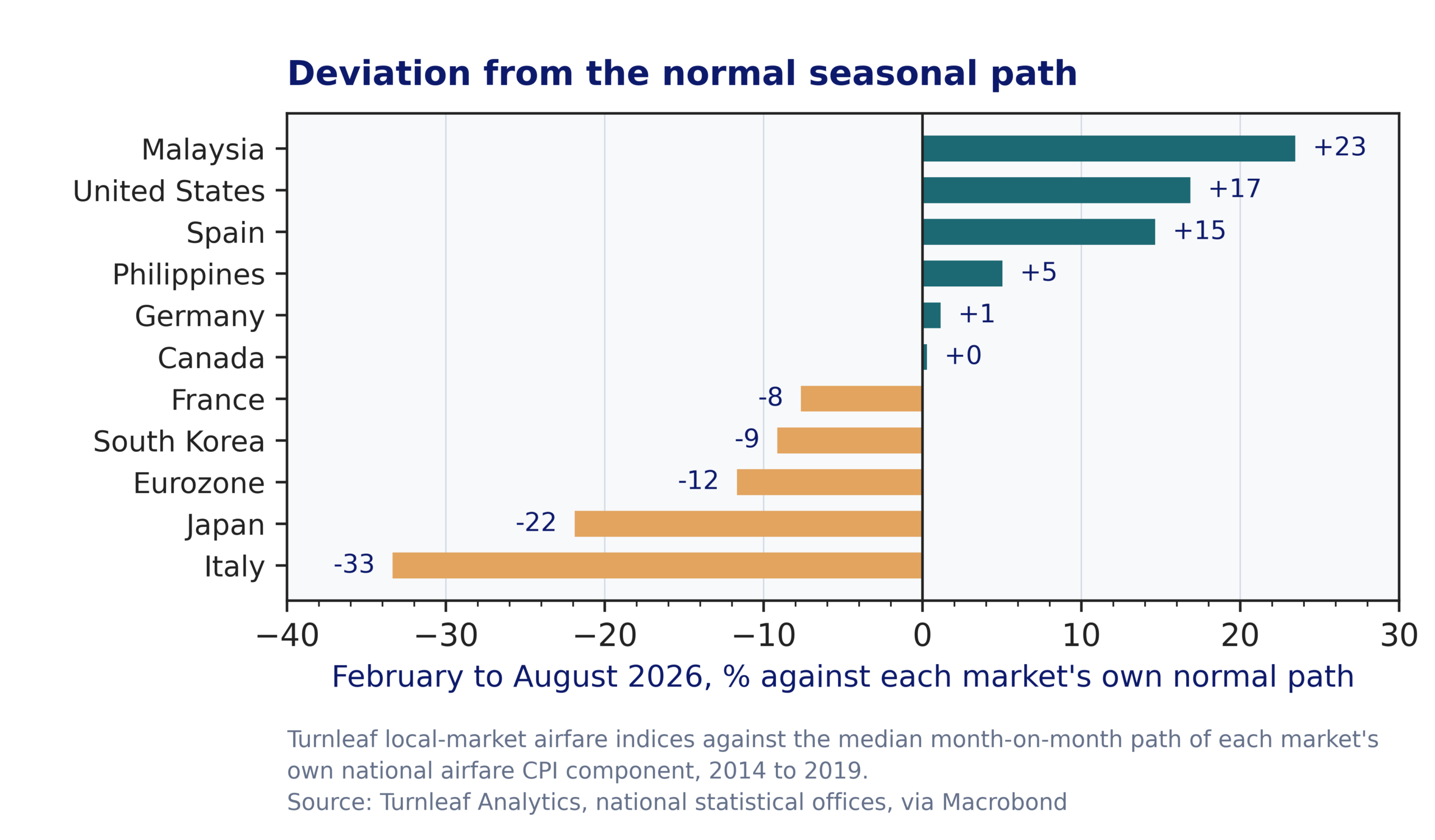
Our retail fuel indices explain much of that split, and fuel policy explains the rest. Japanese pump prices rose 10% between February and August and have been flat since April, because the government holds them near ¥170 a litre, and it subsidises aviation fuel on domestic routes directly, doubling that support to ¥20.9 a litre from 3 September. As a result, the cost shock never reached Japanese carriers. Malaysian pump prices, similarly, rose 8% against the RON95 ceiling, which leaves capacity and demand as the source of the 23% overshoot there. US pump prices, by contrast, stood 52% above February by May, the largest increase in the panel, in the market whose fares moved furthest from their season.
Europe, however, is the exception, because its fuel costs did rise, only late. The euro-area fuel index gained 10.7% in August alone, after drifting lower through the early summer, so most of the increase arrived once summer fares had already been sold. The European pass-through therefore still sits ahead of the prints.
We ran the same measurement on the official CPI components as a check. That puts the United States 15.8% above season against our 16.9%, and the two agree in direction in Malaysia, Italy, Japan and the euro area. They disagree in Canada, the Philippines and South Korea, where the official series sits well above season and ours does not, and in Spain, where ours is well above and the official reading is only 3% above. Those gaps are too wide to come from our head start on the statistical office, and point to differences in route and cabin coverage. We treat the markets where both measures agree as settled, and read the divergent ones for direction alone.
The Turnleaf View
To read the rest, visit our latest Substack post, here.
Research Archive
It’s five to eleven
Whenever I travel somewhere, I like to read books about the place I'm visiting. It helps in way to provide some context for me. Over the years I've been to Portugal many times,...
Macroeconomic Insights: LATAM Fights an Oil Shock
In an earlier post, we explored the lagged correlations between Brent crude oil price changes and CPI (Figure 1). Here, we see that for many LATAM countries pass-through is...
Macroeconomic Insights: Airfares Take Off as Iran Conflict Continues
The war in Iran has persisted far longer than anticipated, driving sustained increases in global commodity prices. These pressures are now filtering into downstream products...
Macroeconomics Insights: Oil Prices Up, Will Food Prices Follow?
Over the past three weeks, the escalation of conflict in the Middle East has coincided with a clear increase in Brent crude prices, reinforcing the expectation of near-term...
Macroeconomic Insights: Iran’s Oil Shock Fuels Inflation
It’s been more than 2 weeks since the US-Israel joint combat mission against Iran began and the conflict doesn’t look like its going to end any time soon. Iran is doing...
Macroeconomic Insights: Energy Price Pass-Through to Inflation
Brent crude has surged from ~$70 to above $100 following the US-Israeli strikes on Iran and the near-closure of the Strait of Hormuz (Figure 1). Dutch TTF natural gas has jumped...
Macroeconomic Insights: Strait of Hormuz and the Inflation Shock Markets Are Repricing
The US-Israel strike on Iran has pushed Middle East risk back to the center of global pricing. Crude has firmed into the low 70s while European gas prices spiked, and gold has...
Macroeconomic Insights: Trump’s Tariff War – The Sequel
On Feb 20, 2026, the Supreme Court ruled 6–3 (Learning Resources, Inc. v. Trump) that the International Emergency Economic Powers Act (IEEPA) does not authorize the U.S....
Macroeconomic Insights: Gold’s New Inflation Playbook
Gold has stopped trading as a clean derivative of US real yields and now reflects a broader external pricing regime. Since 2022, the real-yield anchor has weakened, gold has...
TradeTech FX USA 2026
Over recent years, the finance community in Miami has grown, given that a number of hedge funds have opened up large offices there. Every February, the FX community from New...
Macroeconomic Insights: India CPI – Basket Reweighting Explained
India's National Statistical Office launched a new Consumer Price Index series on February 12, 2026, shifting the base year from 2012 to 2024 and overhauling the basket...
Macroeconomic Insights: UK CPI — Assessing the Renters’ Rights Act 2025
Executive Summary The Renters' Rights Act received Royal Assent on 27 October 2025. Council investigatory powers commenced on 27 December 2025, and the main rent-setting...
Macroeconomic Insights: South Africa CPI – When Currency Strength Meets Energy Vulnerability
After trending downward through most of 2025 alongside rand appreciation and falling oil prices, Turnleaf’s 12 month inflation forecast for South Africa is now pointing at rising...
Macroeconomic Insights: Colombia CPI: The Minimum Wage Shock
Colombia’s 12-month inflation outlook for 2026 has been revised higher. We now expect inflation to hit up to 6.7%YoY by the end of the year (Figure 1). This is a clear break from...
Macroeconomic Insights: Expect the Unexpected
Mark Carney at Davos, January 20, 2026 "For decades, countries like Canada prospered under what we called the rules-based international order. We joined its institutions, we...