
Featured Research
Macroeconomic Insights: CEE’s Deferred Inflation Pass-Through
The closure of the Strait of Hormuz and the wider conflict involving Iran pushed regional fuel and gas costs sharply higher from March 2026. Governments across Central and Eastern Europe (CEE) entered that shock with different administered price regimes already in...
Macroeconomic Insights: CEE’s Deferred Inflation Pass-Through
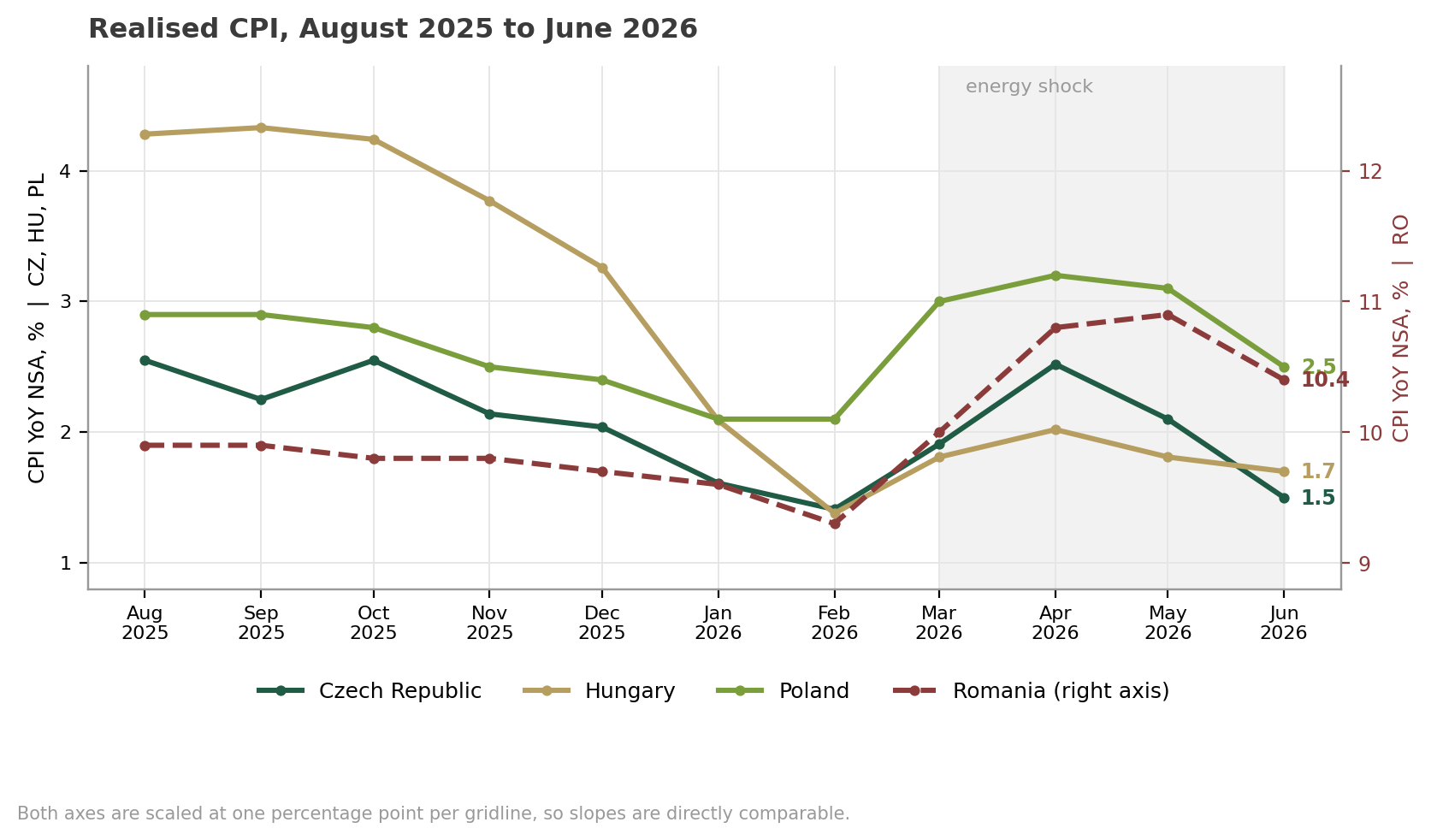
The closure of the Strait of Hormuz and the wider conflict involving Iran pushed regional fuel and gas costs sharply higher from March 2026. Governments across Central and Eastern Europe (CEE) entered that shock with different administered price regimes already in place, and adjusted or extended them at different speeds through the spring. The June 2026 prints show how differently those regimes have landed. Czech CPI printed 1.5% YoY, down from 2.1% in May. Hungary printed 1.7% YoY with prices flat on the month, Poland printed 2.5% YoY and Romania printed 10.4% YoY. We compare the four on June because that is the last month published for all of them, and we treat Poland’s July release, discussed below, as an out-of-sample check on the same vintage. Turnleaf’s June 2026 forecast vintage points to convergence over the following 12 months, but from opposite directions, with our 12-month forecast curves reaching roughly 3.5% YoY in the Czech Republic, 4.9% in Hungary, 5.2% in Poland and 6.3% in Romania by June 2027 (Figure 1).
Figure 1. Realised CPI YoY NSA, August 2025 to June 2026
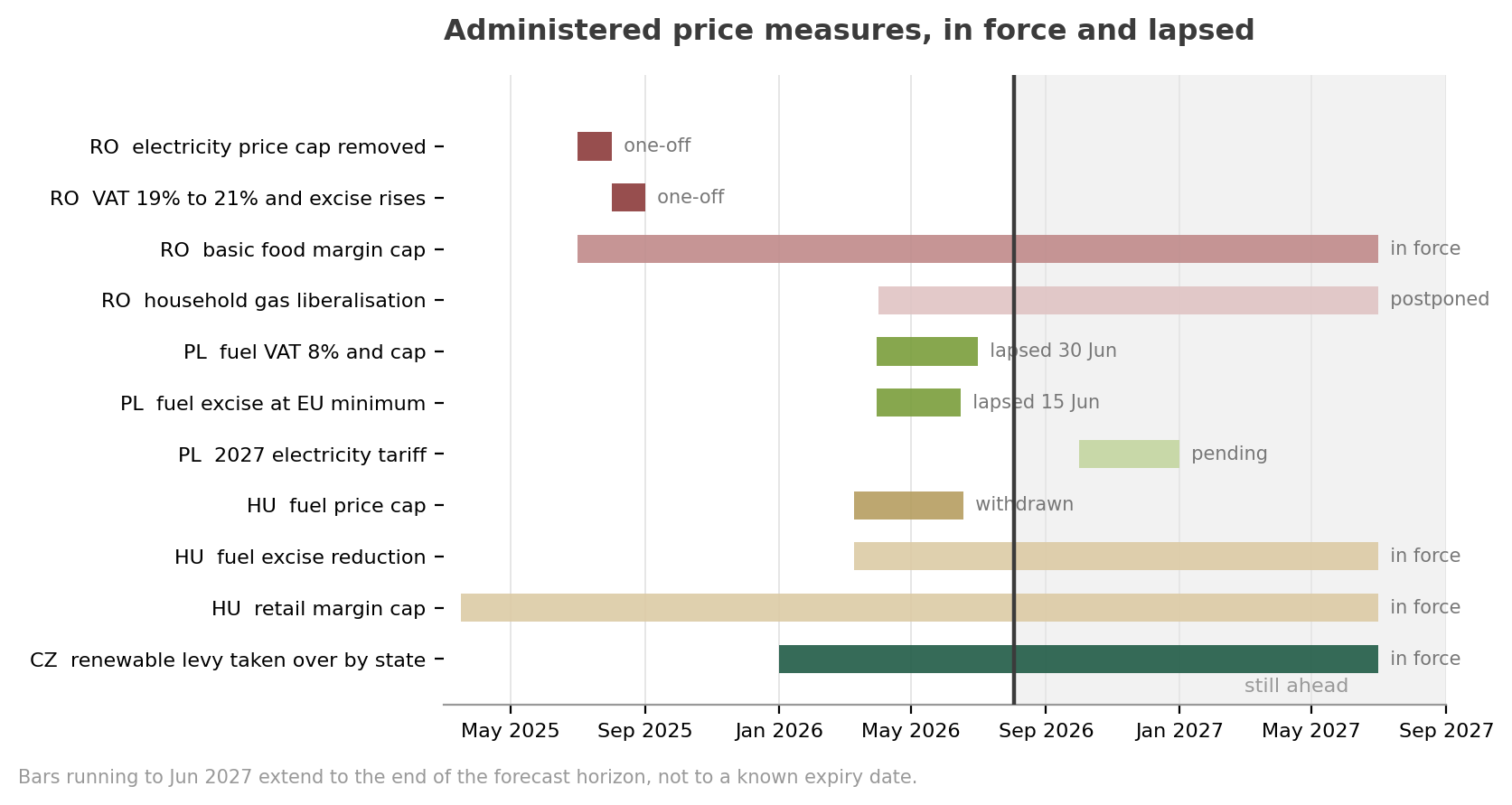
Three dimensions separate the four economies. The first is how much administered suppression remains in place and how much has already been released, which runs from Poland, where the fuel measures have fully lapsed, to Hungary, where the food margin cap remains binding (Figure 2). The second is the direction of travel. The Czech Republic, Hungary and Poland face deferred pass-through, while Romania faces the opposite, a large favourable base effect from its own 2025 liberalisation. The third is where the persistence sits once the energy impulse fades, with imported energy playing the larger role in the Czech Republic and Poland, administered food repricing central in Hungary, and domestic services dominating the Romanian outlook. Our contribution word clouds make that third dimension visible, since fuel and crude indicators dominate the Polish and Czech drivers while the Romanian upward contributions run through household energy and domestic activity.
Figure 2. Administered price measures across CEE, in force, lapsed and pending
Czech Republic
Our curve holds between 1.5% and 2% YoY through the fourth quarter of 2026 before stepping up to roughly 2.4% in January 2027, around 3% in the spring and roughly 3.5% by June 2027, running below the Czech National Bank (CNB) benchmark for most of the horizon (Figure 3). The CNB expects inflation close to 3% in late 2026 and early 2027 before a return towards 2% during 2027. The near-term softness is grounded in the June detail, where food and non-alcoholic beverage prices fell 3.4% YoY and energy prices fell 1.0%, and the administered offset is doing real work, since the government’s decision to take over the renewable energy payment is cutting household electricity bills by around 10% in 2026. Our word cloud puts seasonality, the aggregate food price index and core CPI on the downward side against the Brent crude oil slope 6-12M, Brent 1st dated and the United States EIA crude oil forecast. The risk here is two-sided and unusually symmetric. A second oil leg would arrive before the current favourable food comparison has run its course and would push us above the CNB path, while the energy price correction the CNB already assumes would bring Czech inflation back towards target later in 2027 rather than leaving it near 3%.
Figure 3. Czech Republic, Turnleaf model versus CNB benchmark, CPI YoY NSA – PAID (to access Turnleaf’s 12-month nowcasts for CEE, visit our latest substack post here)
Hungary
This is where our view diverges most sharply from the benchmark. Our curve climbs from 1.7% in June 2026 to roughly 2.7% by December and 4.9% by June 2027, while the National Bank of Hungary (MNB) projection peaks near 5.4% around the turn of the year, leaving a gap of close to 2.7 percentage points in December (Figure 4). The difference is mainly a judgement about the speed of the price-control unwind. The margin cap introduced in March 2025 now covers 43 food products and 30 drugstore categories, and the Finance Ministry said at the end of June 2026 that withdrawal is not on the agenda. The fuel price cap set at HUF 595 per litre for petrol and HUF 615 for diesel has been withdrawn, though the reduced fuel excise duty remains in force. We read the administration that took office after the April 2026 election as favouring a phased exit that spreads food repricing across several quarters. The risk is almost entirely one-sided. The European Commission ordered Hungary in December 2025 to scrap the retail margin limit applied to non-Hungarian retailers, and an externally forced removal would be faster than the phased withdrawal we assume, closing the gap to the MNB path within two prints.
Figure 4. Hungary, Turnleaf model versus MNB benchmark, CPI YoY NSA
Poland
Poland is the clearest case of an administered measure already unwinding. The March 2026 package cut fuel VAT from 23% to 8%, reduced excise to the EU minimum and imposed a daily retail price cap. The excise reduction expired on 15 June and the reduced VAT rate and the cap ended on 30 June. July CPI then accelerated to 3.0% YoY on a 13.9% MoM surge in fuel prices, adding an estimated 0.5 to 0.6 percentage points to the annual rate. Our June curve had already placed July close to 3%, and it continues to roughly 3.9% by December 2026 and above 5% by June 2027, against a National Bank of Poland (NBP) benchmark that stays flat near 3% throughout (Figure 5). The word cloud explains the divergence, with the ProxyFuel fuel price index dominating the upward contributions alongside the International Grains Council grains and oilseeds index, gasoline 1st dated and the Brent crude oil slope 1-12M. The principal risk is the 2027 electricity tariff decision, which is not yet in the vintage and which cuts both ways depending on where regulated prices settle against the previous PLN 500 per MWh reference.
Figure 5. Poland, Turnleaf model versus NBP benchmark, CPI YoY NSA
Romania
Romania is the mirror image of the other three. Electricity prices remained close to 60% higher than a year earlier in June, contributing around 2.1 percentage points to the headline rate, and the base effects from the July 2025 liberalisation are expected to pull annual inflation down sharply from July onwards. Our curve captures that, falling from 10.4% to roughly 6% by September 2026, but it then flattens rather than continuing down, holding between 5.9% and 6.7% for the remainder of the horizon against a National Bank of Romania (BNR) benchmark that keeps falling to around 3.6% by June 2027 (Figure 6). We do not follow it lower because of the services block, where prices rose 13.7% YoY in June with rents up 43%. In our word cloud the ProxyFuel fuel price index and eurozone CPI carry the largest downward contributions while electric energy, gas and central heating, the EIA crude oil forecast and tourist arrivals push the other way, the opposite sign to Poland on the same fuel index. The upside risk is administered and specific, since the Romanian Forecasting Commission has flagged the re-liberalisation of natural gas prices and the removal of the cap on commercial margins for basic food products as upside risks for 2027. The downside risk is that services momentum breaks.
Figure 6. Romania, Turnleaf model versus BNR benchmark, CPI YoY NSA
What We Are Watching
Three national developments will determine whether these inflation paths hold. In Hungary, the key test is monthly food repricing, which will determine whether the largest gap between our forecast and the benchmark closes. In Poland, attention is focused on the 2027 electricity tariff, the final major administered price decision still outstanding in the region. In Romania, the critical variable is services inflation. At 13.7% year on year, it is the main reason our forecast stops short of the BNR’s more pronounced disinflation path.
For the Czech Republic, Hungary and Poland, the principal risk concerns timing. Much of the inflationary pressure is already embedded in the system and is awaiting policy decisions that determine when it reaches consumers. Romania remains the exception. There, the key question is whether underlying domestic price momentum persists after the favourable energy base effects have faded.
Research Archive
The human part of machine learning forecasts
I've seen a few videos showing a robot making a burger (here's one of RoboBurger for example). It seems pretty impressive that a machine can create a fresh burger. However, one...
Takeaways from Eagle Alpha London 2024
Over the years the number of datasets which have come to the market have increased significantly. How do data buyers in the buy and sell side find such data? One way has been to...
Takeaways from Berkshire Hathaway 2024
It's springtime in Omaha. It can mean only one thing, the Berkshire Hathaway shareholder meeting is back in town. It is a relatively unusual event in the financial calendar....
Using experience in financial research
I end up buying a lot of books. Inevitably, I end up reading far fewer books than I end up buying. The unread books peer at me from my bookcase, knowing they'll likely never be...
Forecasts and decisions
A lot of measurements go into the perfect burger. First, there's the patty. What is the weight of the patty? How much fat is in the patty? Then there's the other parts. How much...
We still need to learn to code
If I go to burger joint somewhere outside the UK, I’ll usually look at the price and mentally convert it into GBP. I guess I could use a calculator, but it seems slightly...
Takeaways from TradeTech FX USA 2024
In recent years, more financial firms have begun to open up offices in Miami, in particular a number of prominent hedge funds. It has also been the home of TradeTech FX USA for a...
Different ways to assess forecasts
Let's say you want to know what a burger will taste like. You look at the ingredients, and to some extent you'll be able to "forecast" what it'll taste like. Part of the...
How can we improve inflation forecasts
Just imagine you ordered a cheeseburger. Then low and behold, a salad is brought to your table. The probability of such a thing happening is not zero, especially in a busy...
Hundreds of quant papers from #QuantLinkADay in 2023
I tweet a lot (from @saeedamenfx)! In amongst, the tweets about burgers, I tweet out a quant paper or link every day under the hashtag of #QuantLinkDay, mostly around FX, rates,...
What can Warren Buffett and Charlie Munger teach quants?
I've been a fan of Warren Buffett and Charlie Munger for many years. Indeed, I’ve lost count of the number of times I’ve been to Omaha to hear Warren Buffett and Charlie Munger...
Forecasting Inflation: Can Machines Outperform Economists?
On the cusp of a new year, the question top of mind for many governments, businesses and individuals must be “What will economic growth and inflation be in 2024?” After all,...
Data Insights – Our first high frequency forecast for the United States
We are pleased to announce that we are starting to update our inflation forecasts on a weekly basis. Our first weekly forecast is for the United States, where: our model expects...
Data Insights – What Happened to Eurozone Inflation
Headline inflation for Eurozone was released today (8.5%) and it came as a surprise against the short-term consensus (9%). Our prediction for this reading (8.8%) published one...
Data Insights – Spain Inflation (Not a Surprise)
Headline inflation for Spain was released today (5.8%) and it came as a surprise against the short-term consensus (4.7%). Our prediction for this reading (5.79%) published one...