
Featured Research
Macroeconomic Insights: Hormuz, El Niño and Apparel Inflation
Commercial traffic through the Strait of Hormuz has been severely disrupted since 28 February 2026 and has not meaningfully normalised. Lloyd's List Intelligence counted just 73 transits in the week to 16 August, around 10 a day, against roughly 103 trading vessels a...
Macroeconomic Insights: Hormuz, El Niño and Apparel Inflation
Commercial traffic through the Strait of Hormuz has been severely disrupted since 28 February 2026 and has not meaningfully normalised. Lloyd’s List Intelligence counted just 73 transits in the week to 16 August, around 10 a day, against roughly 103 trading vessels a day before the conflict. Marsh reported additional war risk premiums of 7.5 to 10% of hull value on 22 July, up from 1 to 3% a few weeks earlier. Brent was $93.27 a barrel on 21 August, 37.7% above a year ago, and Dutch TTF gas was €66.52 per MWh, 98.1% higher. A second shock is building in parallel. The US Climate Prediction Center has moved to an El Niño Advisory and now puts a greater than 90% probability on a very strong event through the northern hemisphere autumn and winter. Textiles sit downstream of both. Energy prices set the cost of synthetic fibre and of moving finished garments, and El Niño is an important determinant of cotton yields and availability. Neither has yet registered in clothing and footwear inflation across the major advanced economies. We expect these costs to reach retail prices with a lag of several quarters, and our proprietary apparel index has already begun to reflect that.
Two Channels, Two Speeds
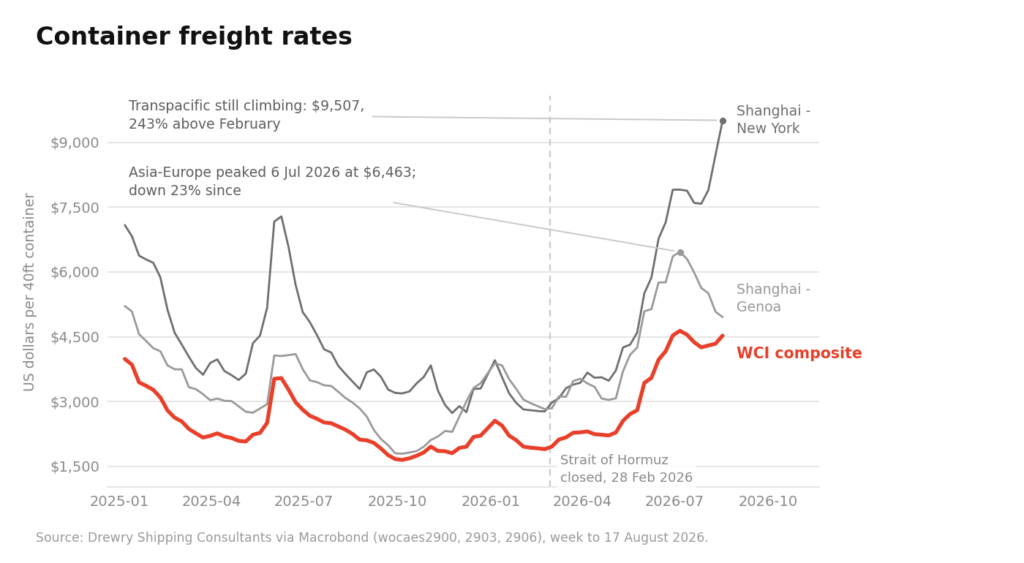
The faster channel runs through energy. Polyester is roughly 59% of world fibre supply against 19% for cotton, which makes the average garment a petrochemical product whose cost moves with crude. That cost has carried through to the fibre itself, with Asian polyester staple prices rising 12 to 15% quarter on quarter in the second quarter as paraxylene followed oil higher. Spot container freight has moved the same way. Drewry’s World Container Index, a weekly composite of eight major East-West lanes, is some 60% above its late-May level, and the move is concentrated on the transpacific, where Shanghai to New York is running at $9,507 per 40ft container, 243% above February, while Asia to Europe has fallen 23% from its July peak (Figure 1). Most apparel volume moves under annual contracts, which reprice with a lag, so today’s spot level indicates what importers will pay at the next negotiation more than what they are paying now. Rebased to January 2026, the month before the closure, European gas was 50% higher in July and Brent 30% higher, and both remain elevated.
Figure 1
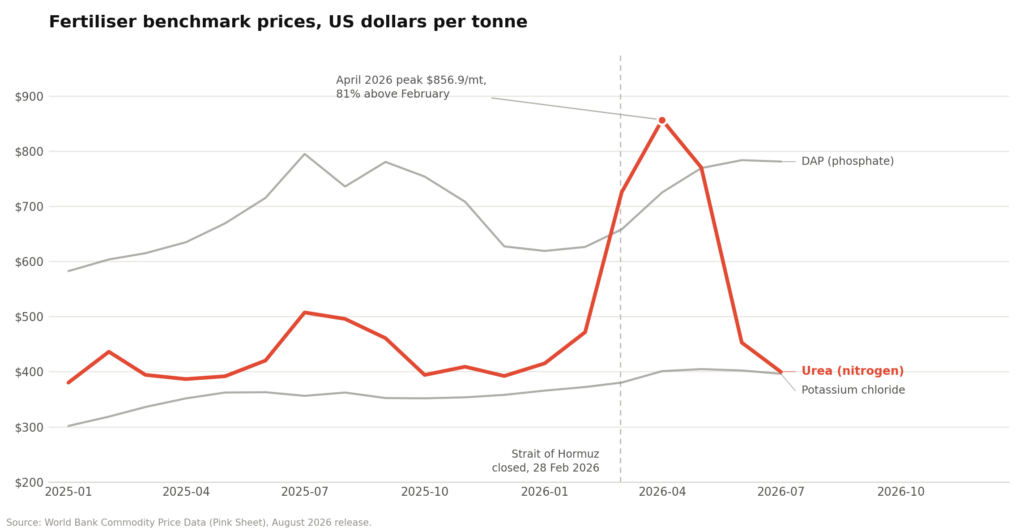
The slower channel runs through agriculture. The fertiliser shock has already peaked and largely reversed, while cotton remains under upward pressure. The Middle East accounts for nearly a quarter of global urea exports, and urea duly rose 81% between February and April before the entire move unwound over the following three months (Figure 2). Phosphates and potash barely participated, because nitrogen fertiliser is synthesised from natural gas and urea therefore traded as an energy derivative through the closure while the mined nutrients did not. Benchmark urea prices have reversed, although that relief has not reached domestic producer prices, with the US producer price index for fertiliser materials still 21% above its January level in July.
Figure 2
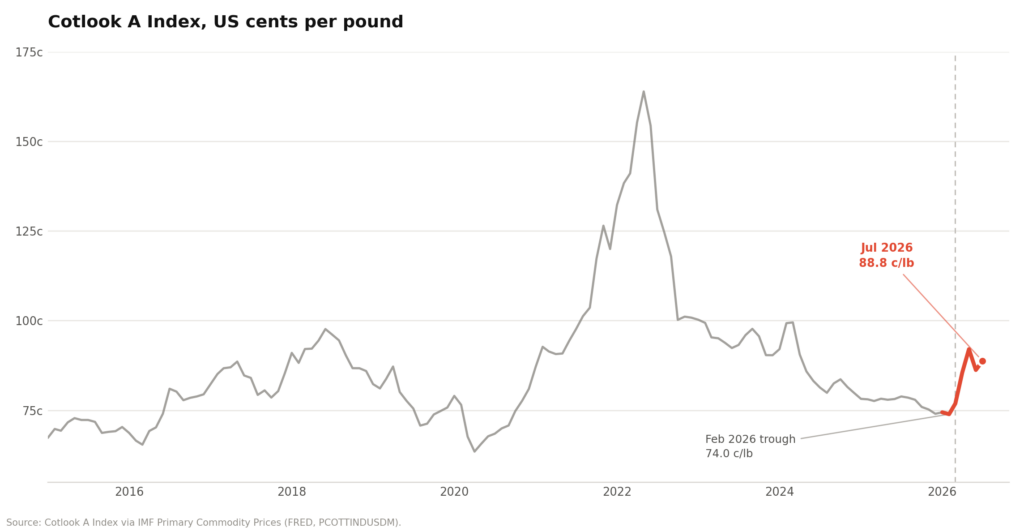
Cotton is where El Niño enters the cost base. India’s June to July monsoon delivered 87% of the long-period average, pushing cotton sowing sharply below year-ago levels before late rains narrowed the shortfall. Prices followed, with the Cotlook A Index rising from a February trough of 74.0 cents a pound to 88.8 cents in July and ICE cotton settling at 88.33 cents on 20 August, 34.2% above a year ago, which leaves the market at its highest since early 2024 (Figure 3). The tightness is structural as well as seasonal, with world ending stocks projected at their lowest since 2011/12 and mill use exceeding production by 5.3 million bales.
Figure 3
What Our Apparel Index Is Showing
To gain access to Turnleaf’s proprietary Apparel indicies for development markets and the rest of this article, visit our latest Substack post, here.
Research Archive
Macroeconomic Insights: Hungary CPI – Food Prices on the Rise
At the end of May 2025, the Orban government decided to extend the profit margin cap on 30 essential food items through August 2025, in line with previous guidance stating the...
Macroeconomic Insights: Vegetable Prices Push India Inflation Downwards
In 2024, volatile vegetable prices repeatedly triggered in-market releases from India’s Price Stabilisation Fund (PSF). PSF, launched in 2014–15, was designed to curb extreme...
Macroeconomic Insights: Israel CPI – The Cost of War
Over the past 24 hours, Israel’s strike on Iran has markedly increased upside risks to inflation in the country. Just as tariffs introduce additional costs to consumers,...
Macroeconomic Insights: Spain CPI – Is it Time to Buy a House?
Since the start of the year, housing market indicators have increasingly correlated with rising inflation pressures. Interestingly, Spain classifies mortgages as financial...
Macroeconomic Insights: United States – A Bad Economy in a Good Economy
Our United States CPI YoY, NSA model continues to flag two quiet but disinflationary forces: a moderate rise in unemployment and trends in disability-program flows. To qualify...
Neudata New York conference 2025
When you're in New York, there are several things you have to have, a burger (preferably from Minetta Tavern), a cookie (preferably from Levain bakery on the Upper East Side) and...
Macroeconomic Insights: Trump Announces a Trade Deal With China. Will U.S. Inflation Go Down Now?
There’s just something about being in Geneva that makes you want to reduce tariffs on all Chinese goods from 145% to 30%. Recently, the U.S. and China reached an agreement to...
Trip notes from USA
Over the past week and half I’ve been travelling in America, starting with Chicago, then Omaha and finally New York. I’ve met many clients and attended various financial events,...
Macroeconomics Insights: Eurozone Inflation and The Price of Fun
On April 28, 2025, at approximately noon, I couldn’t send a message to a colleague. I thought there must have been a problem with my WIFI, until I realized that none of the...
Macroeconomic Insights: China Inflation & The Uncertainty Pandemic
Based on recent weekly forecasts, Turnleaf is projecting deflation of -0.09%YoY in April 2025 as export growth is expected to contract and China begins to reorganize its economy...
Berkshire Hathaway meeting 2025
Go to a fancy London steakhouse, and there will be a chance that you will get served steak from Nebraska. I’ve been to Nebraska many times over the years, and if there’s one...
Macroeconomic Insights: April 2025 Brings Lower Inflation in Hungary and Cheaper Chicken Wings
On March 17, 2025, Prime Minister Viktor Orbán’s government introduced a profit-margin cap across thirty essential goods, beefing up oversight to prevent cross-pricing strategies...
Macroeconomic Insights: Inflation Outlook Israel April 2025 – Key Drivers and Upside Risks
In our April 2025 inflation preview, we project headline CPI will undershoot consensus, underpinned by subdued Brent‐crude volatility, cheaper USD imports due to dollar weakness,...
Macroeconomic Insights: Measuring Inflation in Argentina Through Alternative Data
Just as Turnleaf has been applying alternative data to forecast inflation amid trade policy uncertainty, understanding Argentine inflation requires moving beyond conventional...
Macroeconomic Insights: Tariff Reprieves and Market Uncertainty — Implications for Inflation and Growth
Late last Friday, the U.S. administration announced exemptions for phones, computers, and chips from Trump's tariffs after imposing a 145% tariff against China – a large exporter...