
Featured Research
Macroeconomic Insights: Poland August 2026 CPI, Fuel Taxation and the Grains Channel
Poland's flash CPI for August 2026 printed at 3.4% YoY, up from 3.0% in July and 2.5% in June. Turnleaf's 1 September 2026 forecast holds headline inflation above 4% YoY from the fourth quarter of 2026, peaks it a little above 5% YoY around the middle of 2027, and...
Macroeconomic Insights: Poland August 2026 CPI, Fuel Taxation and the Grains Channel
Poland’s flash CPI for August 2026 printed at 3.4% YoY, up from 3.0% in July and 2.5% in June. Turnleaf’s 1 September 2026 forecast holds headline inflation above 4% YoY from the fourth quarter of 2026, peaks it a little above 5% YoY around the middle of 2027, and ends the horizon near 4.5% in August 2027. Successive vintages have generally shifted the near-term path higher, with the largest revisions concentrated in late 2026 and early 2027 (Figure 1 – to gain access to Turnleaf’s 12-month inflation forecast for Poland, visit our latest Substack post, here).
Poland has suspended and restored fuel taxation twice in six months. The July restoration is what lifted the index, and August’s relief barely reached it. Those two facts together explain most of the path from 2.5% YoY in June to 3.4% in August. Reading the August print correctly means separating what the tax changes did from what prices did.
The first episode ran from 31 March to 30 June 2026, when reduced VAT and excise on motor fuels held pump prices down, and it ended with the restoration of the 23% rate on 1 July. Transport prices rose 7.4% MoM in July as a result, and Statistics Poland puts the division’s contribution to July’s 0.8% MoM headline at 0.73 percentage points. That covers most of the 0.5 percentage point step from 2.5% to 3.0% YoY. Underlying pressures changed little, with core inflation excluding food and energy edging from 3.0% to 3.1% YoY. The tax reversal therefore explains nearly all of the July increase. If the full transport-price rise is attributed to fuels, this implies a motor-fuel weight of roughly 5.4% in the CPI basket, although that estimate is somewhat overstated because the transport division also includes vehicles, airfares and other transport services.
Turnleaf’s proprietary Poland Fuel Index tracks pump prices between official CPI collection periods. Figure 2 shows the sequence clearly. The index fell from its March peak after the first support package took effect, remained lower through the second quarter, then fully reversed in July when the 23% VAT rate was restored. Prices subsequently eased again through the second half of August. That latest decline may not yet be fully reflected in the official CPI index.
Figure 2. The Turnleaf Poland Fuel Index. Shaded bands mark the two fuel-tax episodes and the 5 to 22 August price-collection window.
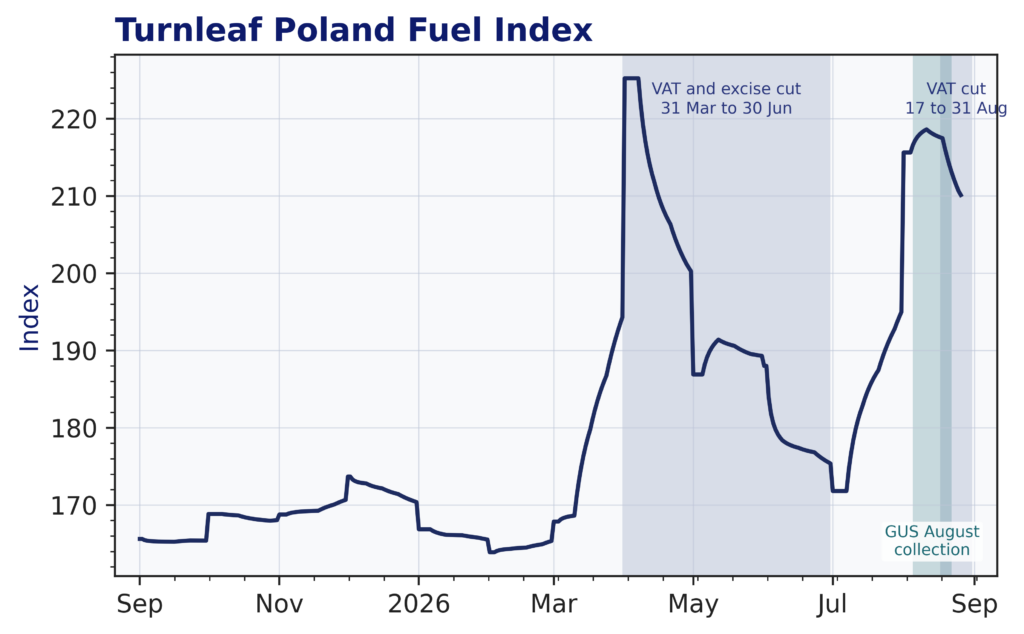
The government reinstated the 8% rate on 17 August 2026, alongside daily maximum retail prices set by the energy ministry, with the measure legislated only through 31 August. Mechanically, cutting VAT from 23% to 8% would lower pump prices by about 12.2%. At an estimated 5.4% CPI weight, that would imply a 0.66 percentage point drag on headline inflation. Pump prices, however, fell by much less. Turnleaf’s Fuel Index declined by around 4% between mid-August and the end of the sample, implying a headline effect closer to 0.2 percentage points. The statutory calculation therefore overstates the actual pass-through, as price caps and compressed retail margins absorbed much of the tax cut before it reached consumers.
Timing further reduced the effect captured in August. Statistics Poland collects prices between the 5th and the 22nd of the month, with motor-fuel quotations taken across that window to reflect changes over the collection period. Because the measure only took effect on 17 August, it applied during only part of the August collection window. As a result, little or no reversal should be expected in September, while the final August CPI release will show how much of the decline was captured. August also provides a cleaner read than July on underlying non-tax pressures, although the headline print remains heavily distorted by fuel, which rose 5.2% MoM and 24.2% YoY.
Fertiliser and Grain Pressures Build Into 2027
Grains carry the larger source of pressure, with fertiliser the most likely transmission channel. The Strait of Hormuz disruption sharply reduced Middle Eastern nitrogen exports, and the region accounts for close to a quarter of global urea supply. Iran halted ammonia production, while Qatar suspended urea and ammonia output. Urea prices rose 80% between February and April, and the World Bank expects its fertiliser price index to rise by more than 30% over 2026, leaving fertiliser affordability for farmers at its weakest since mid-2022. Wheat is the single most important predictor in our Polish food specification, reinforced by the International Grains Council Grains and Oilseeds Index.
The effect on consumer prices should arrive gradually, with the full transmission taking roughly a year. Farmers purchase nitrogen around planting, embedding higher 2026 input costs into the 2026/27 crop. Those costs then feed into grain prices, followed later by retail food prices. Wheat futures suggest that the second stage is already under way, with Euronext milling wheat trading near EUR 227.5 per tonne for September 2026 and around EUR 240 per tonne for March 2027. Freight costs add further pressure as higher shipping and insurance costs constrain Ukrainian and Russian grain exports despite broadly intact production. Our model captures this global freight pressure through the Xeneta Shipping Index for Far East to US West Coast, which serves as a proxy for broader container-shipping costs.
Turnleaf’s Outlook
Most of the uncertainty around the mid-2027 inflation peak therefore comes from grains. If Hormuz traffic normalises soon enough to restore Qatari and Iranian nitrogen supply before 2026/27 planting decisions are fully locked in, part of the fertiliser shock could unwind before reaching the crop. Based on our model sensitivity, that would lower the projected inflation peak by roughly 1 percentage point. If the disruption instead extends into a second planting season, higher input costs would compound and prolong the food-price effect.
A prolonged energy disruption could also increase the likelihood of a third Polish fuel intervention. Such measures create temporary volatility in both MoM and YoY inflation because they lower the price level while in force, before reversing through expiry and subsequent base effects. Nitrogen and grain prices will therefore provide the earliest signal of which food-inflation scenario is developing. Turnleaf’s Poland Fuel Index would capture any renewed fuel intervention ahead of the official CPI data, while the September and October food prints will show whether food deflation, at -0.9% YoY in August after -0.4% in July, has begun to reverse.
Research Archive
Macroeconomic Insights: Gilt Selloff, Autumn 2026 Budget
The Autumn 2025 Budget, scheduled for 26 November, is expected to deliver substantial fiscal tightening. Independent forecasts estimate a tax-raising package in the region of...
Macroeconomic Insights: US CPI — Shutdown Distortions Shift the Focus to November
The 43-day U.S. government shutdown has materially degraded the quality of October’s inflation data. With BLS field operations suspended for the duration of the collection...
What would you have said?
I recently went back to Imperial College. Whilst, I've been back many times since I graduated, this was the first time that I was returning to stand in front of an audience to...
Macroeconomic Insights: Norway CPI – Hey It’s Okay, Mistakes Happen
The Norway Statistical Institute recently revised the latest CPI print from 3.3% to 3.1%, correcting an error in electricity-price calculations that overstated inflation. Despite...
Macroeconomic Insights: Abu Dhabi GDP Forecast
Turnleaf expects Abu Dhabi GDP growth to slow to 2-3%YoY in the next two quarters before hitting 7%YoY in 2026Q1 and then falling back to a bit over 3%YoY by June 2026 (Figure...
Macroeconomic Insights: Switzerland CPI – Escaping Deflation
Turnleaf expects Switzerland inflation to oscillate around 0% over the next 12 months with some indication of healthy price growth towards the tail-end of our forecast (Figure 1...
Macroeconomic Insights: Japan CPI – Nigiri Sushi Inflation
As of September 2025, Japan's inflation profile remains dominated by food price dynamics. The headline 2.9% YoY reading reflects a disproportionate rice contribution—despite...
U.S. Government Shutdown and the October 2025 CPI Print
The BLS released the September 2025 CPI print on October 24, nine days after its originally scheduled October 15 release date, following a partial recall of staff during the...
Quant Strats London 2025
Quant Strats has been a feature of the quant calendar for a number of years. I went to my first event recently after a couple of years. The event has evolved somewhat over time,...
Macroeconomic Insights: Brazil CPI — Food Costs, Currency Dynamics, and the Path to 4%
Brazilian inflation has proved particularly sticky, driven by persistent wage growth, global trade dynamics, and elevated food inflation from weather-related supply constraints....
Macroeconomic Insights: UK September 2025 CPI Analysis
UK CPI for September 2025 declined to 3.8% YoY, falling below market expectations of 4.0% (vs. Turnleaf estimate of 3.94%). The decline was primarily driven by sustained lower...
Macroeconomic Insights: Japan CPI – Subsidies Reset
Japan’s CPI over the next two months will be shaped by a mix of expiring and newly introduced subsidies. Over the past two years, national electricity and gas subsidies have...
Macroeconomic Insights: Australia CPI – Could Higher Unemployment Change Everything?
Turnleaf expects Australia's 12-month inflation forecast path to remain close to the Reserve Bank's upper bound 3% target range as stronger than expected demand continues to...
Macroeconomic Insights: China CPI — Will the Chinese New Year Be Enough?
China's headline CPI rose to -0.3% YoY in September 2025, still capped by food deflation and soft energy prices. Core CPI printed 1.0% YoY, above headline but still subdued as...
Macroeconomic Insights: United States CPI – Core CPI to Drive Inflation Trends
Core Goods and Core Services are steering U.S. inflation in the second half of 2025. According to Turnleaf’s U.S. inflation models, Core Goods will be driven by short-lived...