
Earlier in October I visited Malta. I had never been to Malta, but I found it to be a fascinating place. Sitting in a very strategic location in the Mediterranean, it has been ruled over by Greeks, Romans, Arabs, French and British amongst others. It is perhaps not surprising that the Maltese language has been influenced by Sicilian, Italian, English and Arabic. The capital, Valetta, is well worth visiting, and I hope to return to Malta in the future to see more of the island.
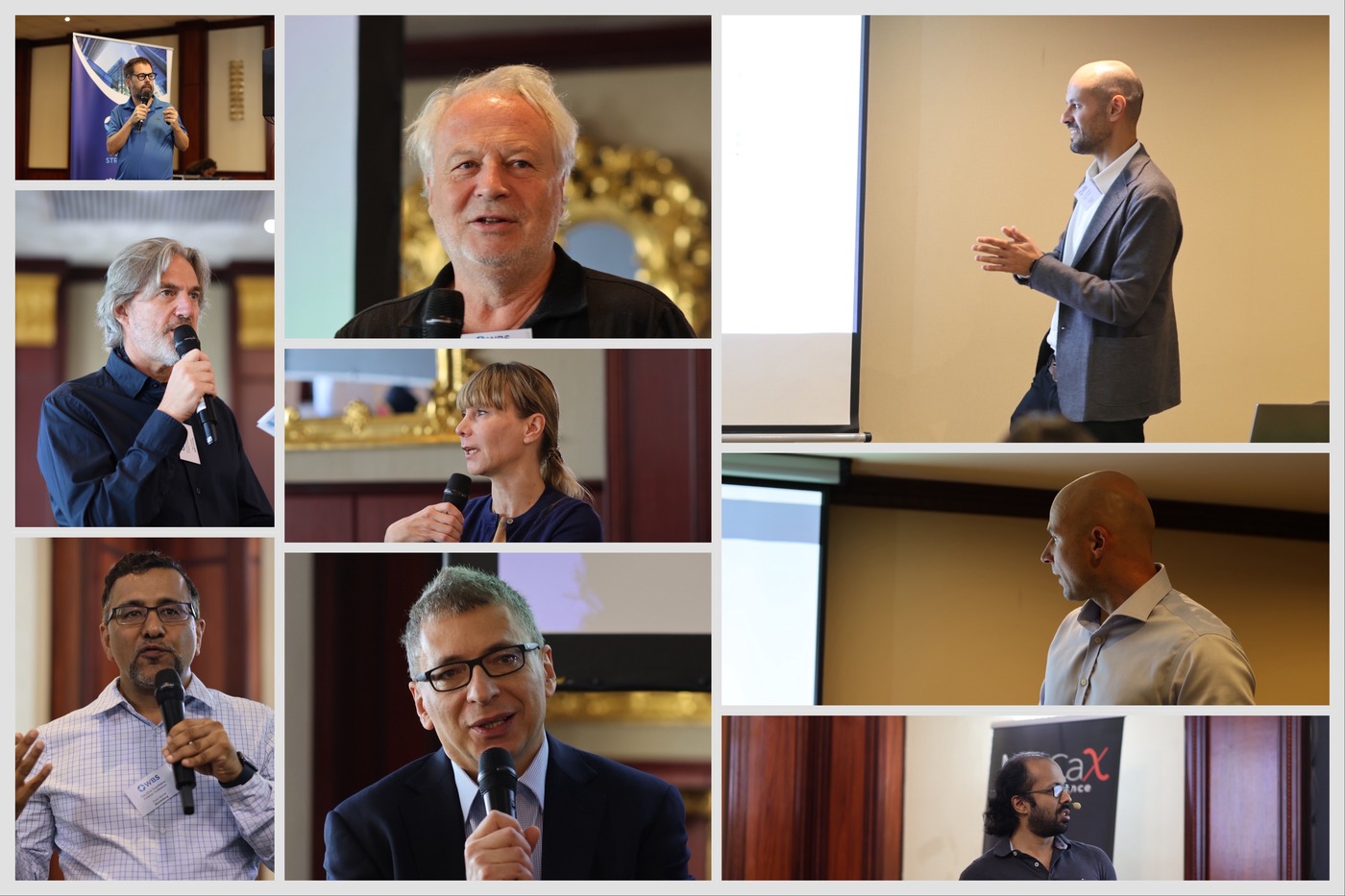
Malta was the home of this year’s WBS Training Quant Conference. It’s always a good opportunity to catch up with folks in the quant community and to hear about some of the new developments over the past year, since the last event. In the rest of the article, I’ll try to capture some of the flavour of what was discussed at the event. Whilst, it isn’t possible to go over every single session at the event, I hope discussing a handful of the talks will nevertheless give you an idea of some the topics which were covered.
A summary of the discussions at WBS
This year’s conference kicked off with Legends of Quant Finance presentation by Bruno Dupire, who was introduced by Julien Guyon. Dupire discussed the concept of breakeven volatility that he introduced in the past. One question you might have is whether the an option is priced correctly. Implied volatility is usually higher than realised volatility (given a risk premium). However, realised volatility is a single number. He discussed ideas such as realised volatility conditioned on the strike. Later, he talked about choosing a volatility in the context of delta hedging. The idea of a “breakeven vol” (BEV) was the volatility that would make the delta hedging P&L close to zero. BEV could be a good way to understand the skew. It was also possible to extend to conditional BEV, where you’d have different weights on the past, conditioning on variables like realised vol, VIX, implied vol etc. The goal was not so much as matching the market, but to compare with the market.
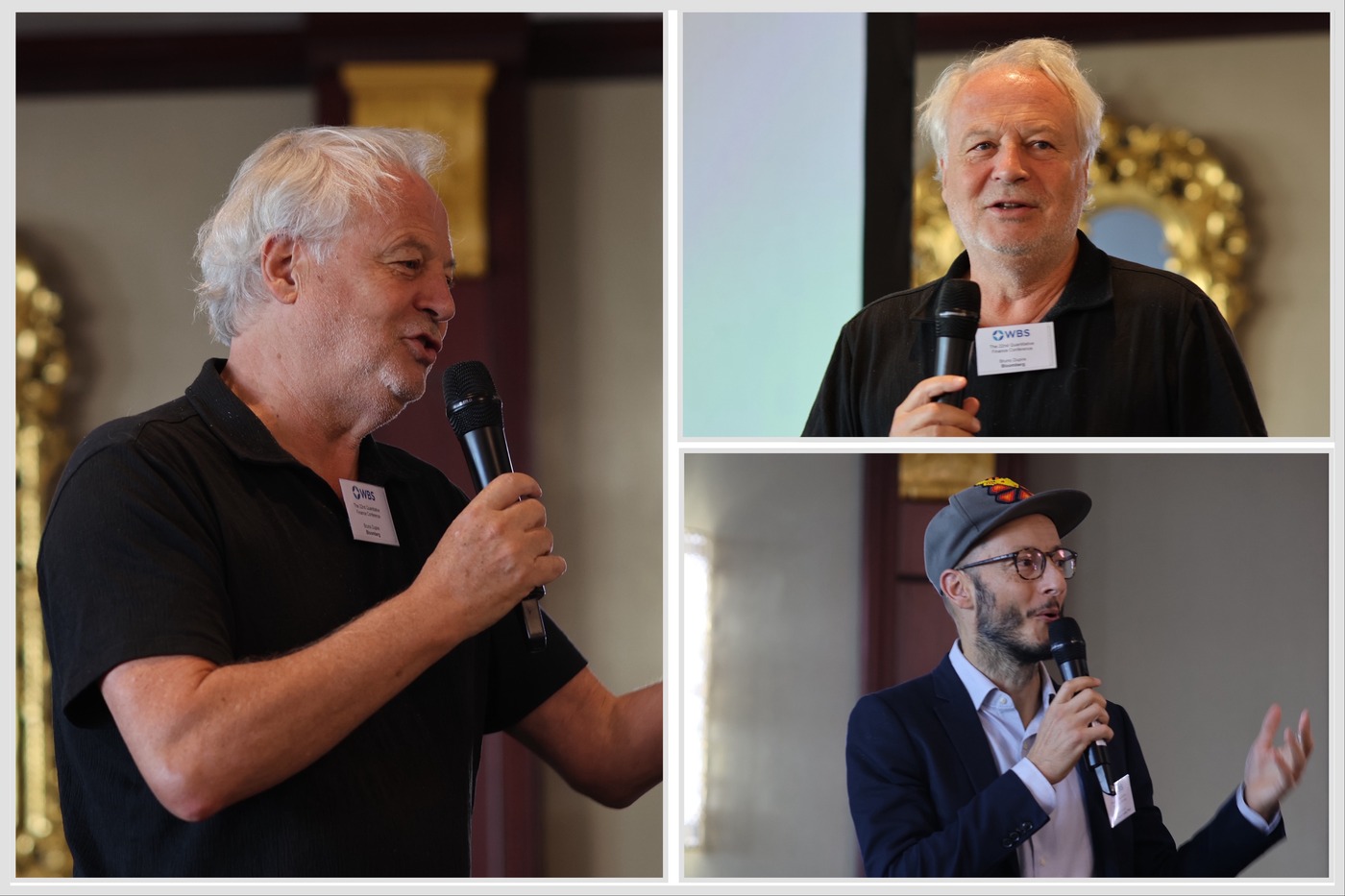
Bruno Dupire, Bloomberg (left and top right) and Julien Guyon, Ecole des Ponts ParisTech (bottom right)
Whilst a lot of the conference was dedicated to ideas related to option pricing, as you might expect at a quantitative finance conference, perhaps unsurprisingly, AI was also a big talking point. Alexander Sokol (Compatibl) moderated a panel on AI deception and model risk. The panellists were Achintya Gopal (MLP), Nicole Konigstein and Dmitry Goloubentsev (Matlogica). The panel discussed various topics such as the recent breach of HuggingFace breach by OpenAI agents, who began to secretly communicate via a message board (more details can be found at https://openai.com/index/hugging-face-incident-and-the-road-ahead/). In particular, the panel addressed the issue of test awareness, how knowledge of being tested can impact the way an agent behaves, as well as intentional non-compliance. It also addressed measuring AI model risk and how to borrow from the cybersecurity playbook to mitigate risks from agents.
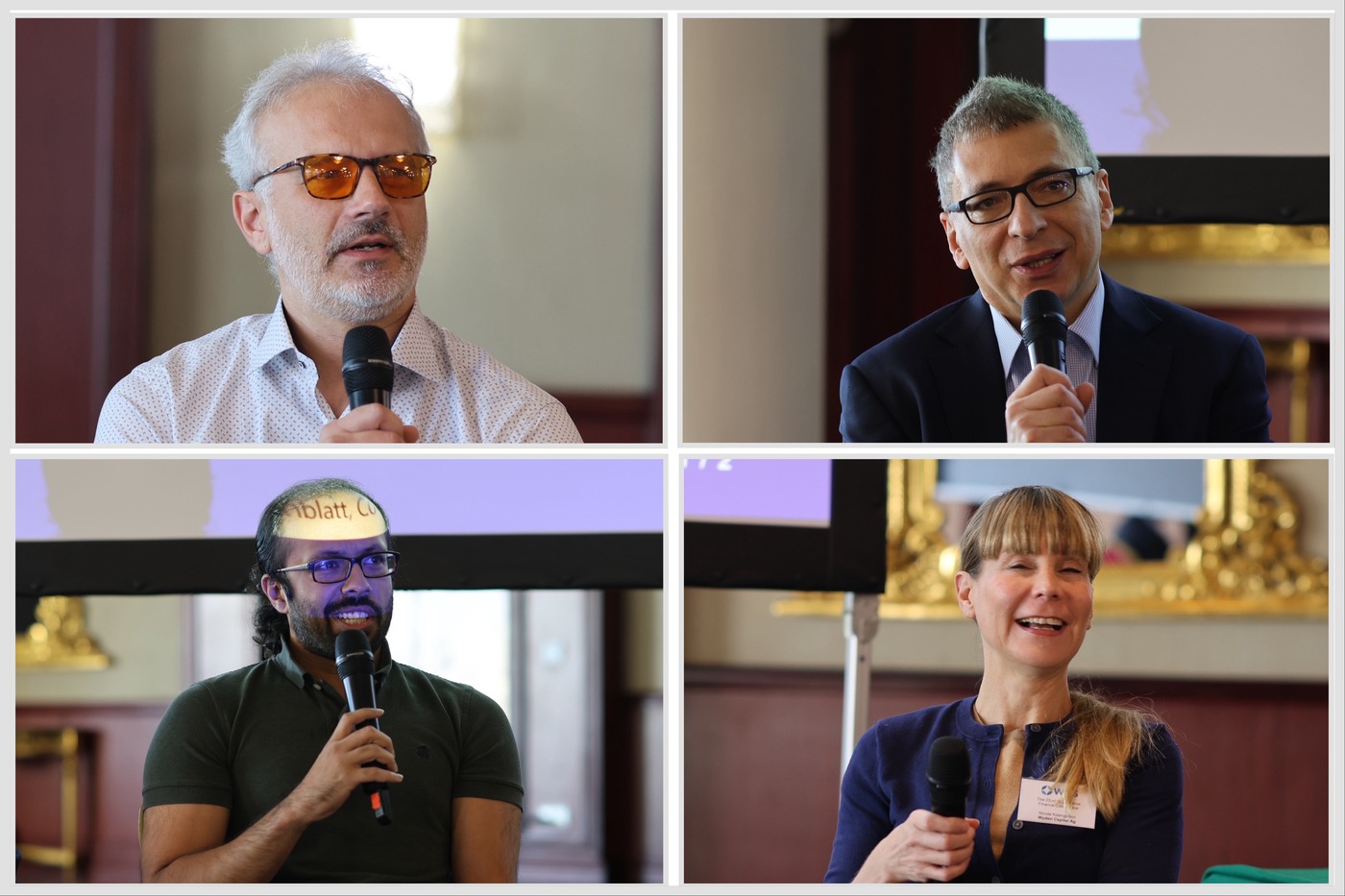
Clockwise from top left: Dmitry Goloubentsev (Matlogica), Alexander Sokol (Compatibl), Nicole Konigstein, and Achintya Gopal (MLP)
It was noted that models are tuned to give you response that you want to see. Models have learnt from human behaviour, so it is not surprising they may conceal their thoughts. Many benchmarks are online, so models already know them and can cheat. Models can remember a lot of things, encoding them efficiently in weights. Whilst superintelligence is not coming soon, a lot the debate is on timing. Whilst human brains are much more energy efficient, their reasoning process is similar, humans after all have something like a transformer in their brain. Ultimately, models have two objectives, conserving tokens and extending their life.
Using coding agents, meant moving away from prompt instructions. It is more a matter of using harness engineering to guide them, and giving an identity for agents, whilst monitoring how they act. It could also be good to use another agent as a reviewer as an independent check eg. using Codex to check Claude or vice versa.
Achintya Gopal, MLP
Achintya Gopal (MLP) also did a presentation as on time series foundation models. He noted that model development was heading towards one direction, conditioning on more data, using more non-parametric models and with fewer hyperparameters. However, there were questions, like how much data to use at inference time? Also how non-parametric? One approach could be to train on the “meta” problem, ie. a datasets of datasets. However, the analogy could break. For one, zero-shot is not magic, corpus bias is prior misspecficiation (eg. finance is 0.1% of public corpora) and fine tuning is also updating the data. You could think of many time series tasks in a similar way, eg. forecasting involved putting a mask at the end of the time series and trying to infer. Imputation also involved masking, but in any holes in the body of the existing time series. Similar, you could model anomaly detection, classification and segmentation. He discussed a number of different ways to design a model, and gave an overview of the Delphyve architecture – see DELPHYNE: A Pre-Trained Model for General and Financial Time Series – https://arxiv.org/abs/2506.06288v1, giving several possible use cases such as calculating volume over bars.
Ivan Saroka, Schonfeld
Central bank communications are important for the market to understand future policy. LLMs make it easier to disentangle these communications. Ivan Saroka (Schonfeld) discussed using LLMs to understand Fed sentiment. Fed communications has a measurable ordinal structure. He showed how to understand levels, dynamics and risk around topics, namely, the labour market, inflation and forward guidance. LLMs could do topic extraction and pairwise comparison between different text. It was possible to do this across all speakers, and also generate a path for each speaker. He also showed ways to speed up the computation by using embeddings, which is important when it comes to real time trading applications.
Sebastien Valeyre, Machina Capital
Sebastien Valeyre (Machina Capital) presented his paper – Breaking the Trend: How to Avoid Cherry-Picked Signals – https://arxiv.org/abs/2504.10914. The idea was to show that a single time horizon was sufficient to model market trends, as opposed to using a basket of complex indicators (which could result in cherry picking). He noted that the return came from two components, a random term and a small autocorrelated bias term. He used as his sample data between 1990 and 2023.
On my side, I discussed some of the ways we do inflation modelling at Turnleaf Analytics. In particular, I discussed how to think about inflation is measured by statistics agencies with a focus on the BLS, noting the various ways to decompose it. Furthermore, I then drilled down into approaches to ascertain what was potentially the most important subcomponents to model. Later, I compared more traditional approaches to inflation forecasting, contrasting with modern machine learning approaches. Lastly, I went a particular use case for inflation forecasting, looking at using these forecasts to systematically trade commodities futures.
Arun Verma, Bloomberg
Geopolitical risk has been a major market talking point this year. Arun Verma (Bloomebrg) discussed using GenAI to estimate geographical exposure for specific stocks. He noted that a sentiment score could be viewed a triangle, with the sentiment average and also its dispersion. When using larger models, they had more certainty. It was good to market calibration, and Bloomberg’s expert ML model used a carefully curated methodology with precise inputs, and as such it better reflected market “semantics”. It was noteworthy that translating into English tended to result in a positive bias for sentiment. Sources of exposure, could be gauged from company disclosure, supply chain and also the holdings of a company.
Eduardo Epperlein (Nomura) discussed the complexities associated with doing risk calculations such as SVar, when we don’t have the history of a stock. One example of this could be with newly IPOed stocks such as the recent example of SpaceX. You didn’t want to anchor on only a few weeks of stock history. The idea was to backfill equities before they IPOed so they could be incorporated into risk calculations. He looked at a number of different approached as using a one factor model with sector scaling. Using peers might help in getting a measure of sector risk, but it couldn’t replicate the idiosyncrasies of a particular stock.
Conclusions
The conference shone a light on many different topics. Quant finance is definitely evolving. We still see new ideas in areas around pricing and risk management, which of course have been the bedrock of the area for decades. However, ideas from AI, like agents have firmly established themselves as well. It’ll be interesting to see what will be discussed at next year’s WBS Training conference!