
A decade ago, I liked burgers, and a decade on, well, I still like burgers. However, one thing that has changed greatly has been the alternative data market. What was once an idea which was very niche for major quant funds and a small number of discretionary firms has now opened up to the mainstream. A decade ago, Neudata was founded to bring together buyers and sellers of alternative data. I attended their London conference this week. I’ve attended many of their events over the years, the first of which was in 2018. It has been great to see how the events have grown so much over the years, a testament to the founder, Rado Lipus and the team. The conference was great opportunity to celebrate ten years of Neudata and also the maturing of the alt data industry.
In this article, I’ll try to go over some of the takeaways from the event and the various sessions I attended. There is the obvious caveat that it’s only a summary and can never be comprehensive, but I’ll nevertheless try to give a flavour of what was discussed. The conference kicked off with Daryl Smith (Neudata) discussing the current state of the alt data market. He noted that on the buy side the AI spend had been geared towards internal productivity. The supply of alt data was also increasing, hence, there were fewer users on a per dataset basis. He also noted that demand for globally applicable datasets had been rising sharply: as an aside Turnleaf Analytics inflation forecasting is global and covers 36 economies, over 90% of the world’s GDP!
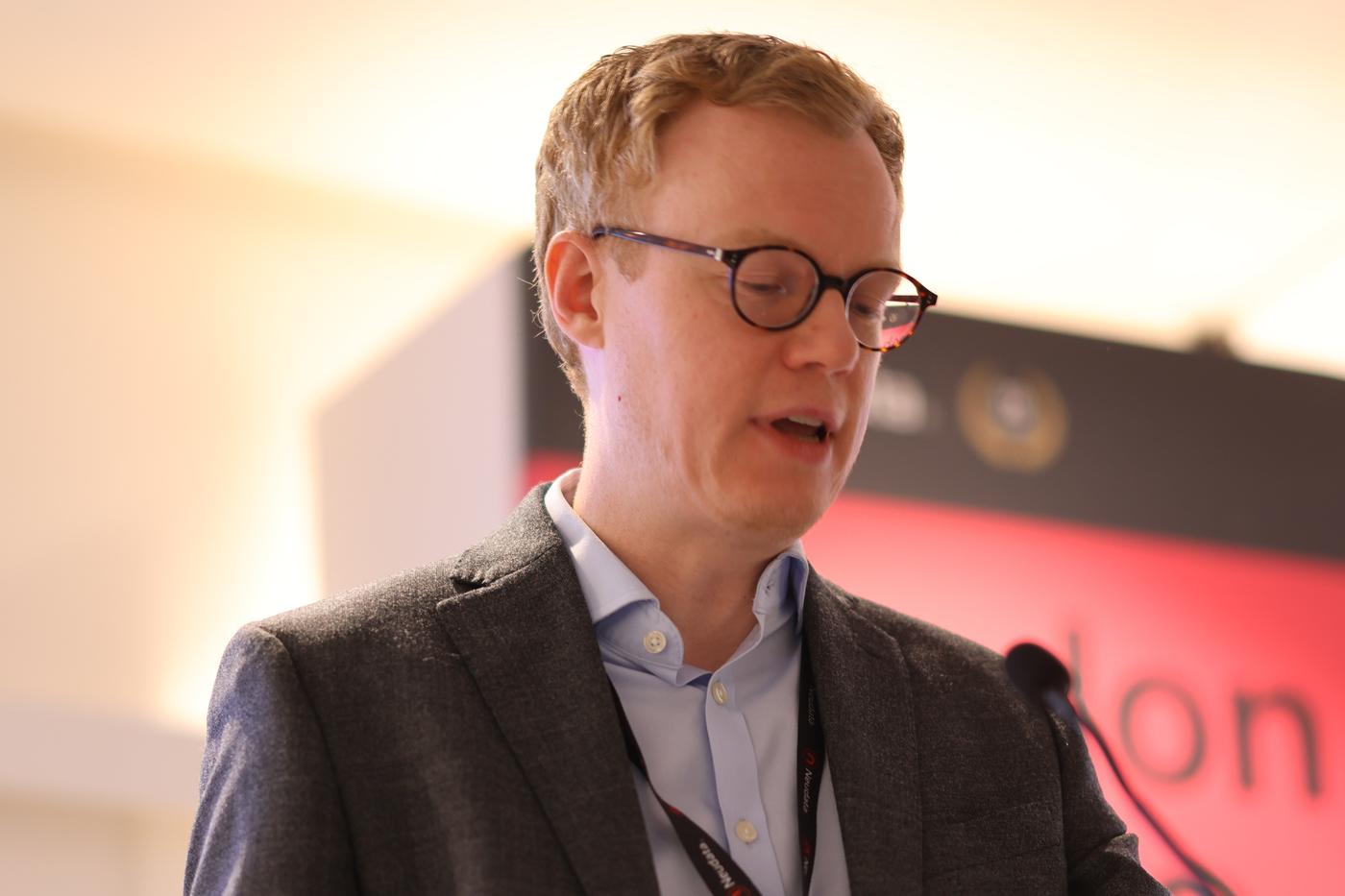
Daryl Smith (Neudata)
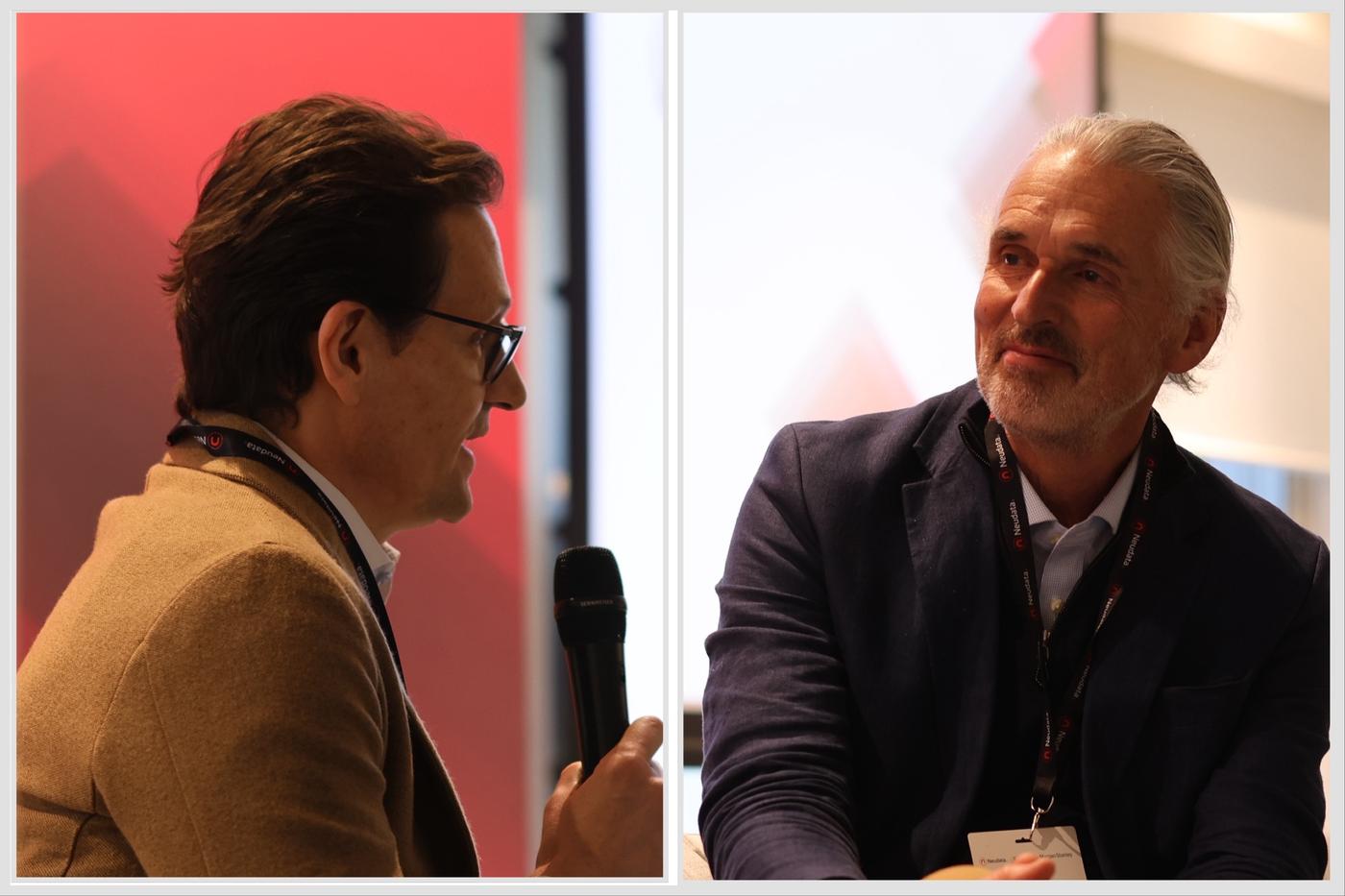
The founders interview
Rado Lipus (Neudata) interviewed Mark O’Hare discussing O’Hare’s time in the data industry with a focus on Preqin, which he sold to BlackRock last year for 3.2bn USD. It was a very interesting interview, and it a lot of insights about both founding and growing a data firm.
O’Hara noted how in 2002, when he founded Preqin, private equity was a lot smaller as an industry (around 50bn USD versus many trillions today). It was poorly served when it come to data. He wanted to provide good data on fund performance to help LPs to pick their investment. It was an obvious opportunity. Whilst starting a data firm is “asset light”, he did initially put in a small amount of cash, and didn’t take any salary for a few years. Validation in the product came when customers started to buy it. After a few years they reached 1mm USD ARR, and there was a pivot from “survival mode” to a scale up. He also talked about the initial challenge was getting into the industry, but later on it was possible to divide up the product and also upsell. He also talked about how sometimes you are wrong, and you’ll have to kill idea. Equally, it was important to listen to the team. His intention was to own the business long term and put it into his family. His trigger was not so much a desire to exit, but that the dynamics of the industry was a challenge, and in 2023 began to explore possibilities. In terms of the future, O’Hara had a lot of advice. He suggested keeping things simple. The world is becoming more data driven: the demand for data is only going up. AI was changing the world of data provision, and he discussed how proprietary data could be a moat.
Decade of alt data
Daryl Smith (Neudata) chaired a panel discussing how alt data had evolved. The participants in the panel were Rado Lipus (Neudata), Marc Noet (Dataprovider.com), Tony Berkman (former Two Sigma) and Tjeerd Van Capelle (aiLiftoff). The panel kicked off with Lipus talking about the early days of Neudata. He left a previous role in 2015, and thought to start a business then. At the time, there was a very small market of alt data providers in the US. The talk was of big data then, as opposed to alt data. There was a lot of talk, but what did people use it for? The question was where do you find this data? This question became an obsession. Whilst at the time there was no clear plan, that was the origin of the whole Neudata idea. He later noted that at the beginning clients were systematic equity funds, and traditional asset managers were not keen. However, when COVID came, it drove demand in alt data. The various virtual events during that period also reached users who were previously interested, and it broadened the demand side. That was also my feeling working in alt data, after COVID the interest increased massively. Obviously, it was not planned, but the Book of Alternative Data, which Alexander Denev and I cowrote, seemed to come at the right time, as we published it in 2020.
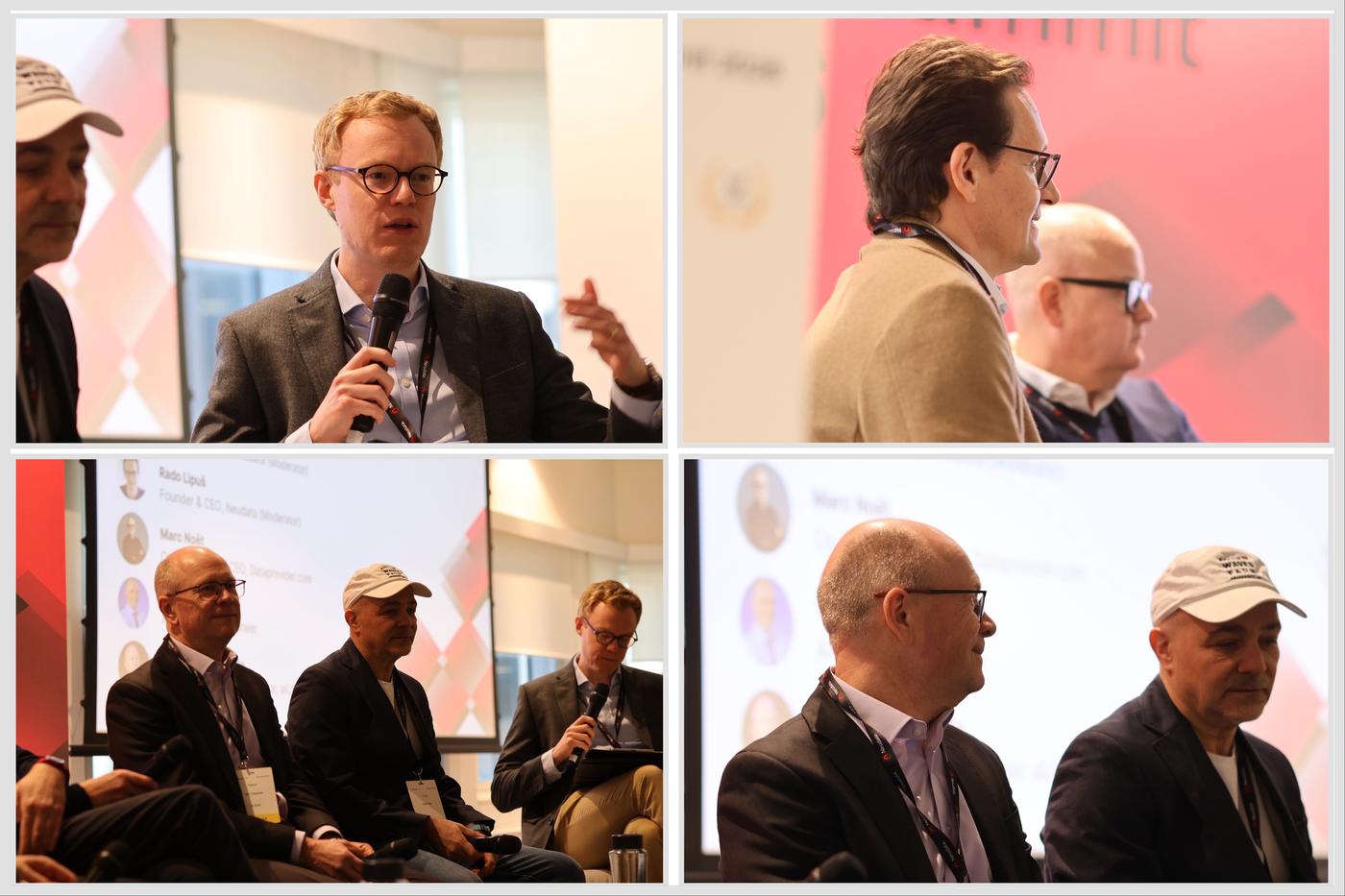
Daryl Smith (Neudata), Rado Lipus (Neudata), Marc Noet (Dataprovider.com), Tjeerd Van Capelle (aiLiftoff) and Tony Berkman (alt data pioneer) – clockwise
Tony Berkman also chimed in about the early days of alt data. He’s the founder of Majestic Research, and one of the pioneers in alt data, and he’s worked on the buy side both in discretionary and systematic firms. He noted how it was actually at Majestic, that they coined the term “alt data”. In the early days, there was a lot of push back, for example from long only firms. Post RegFD (fair disclosure) regulations, there was reduced access to management, and alt data became more attractive. Now everyone is incorporating alt data, even corporates. He also discussed his thoughts about how AI could really change things in the industry.
Marc Noet discussed his path to alt data, noting how it actually came from outside investing. Initially he had developed a product primarily for PayPal to identify web stores that didn’t use PayPal. After meeting Lipus and a quant conference at Goldman Sachs, he learnt about alt data and from that point he got his first quant client.
AI’s impact on investment research
The team from Morgan Stanley discussed how AI was changing how they did investment research. Sophie Beland (Morgan Stanley) and Paul Walsh (Morgan Stanley) talked about the team sits down every year to establish the themes likely to drive market in the coming year (and indeed years) ahead, and to have a pipeline of content around that. Topics at present include AI disruption, multipolar world dynamics, defence and the future of energy (where the focus has shifted more to energy security).
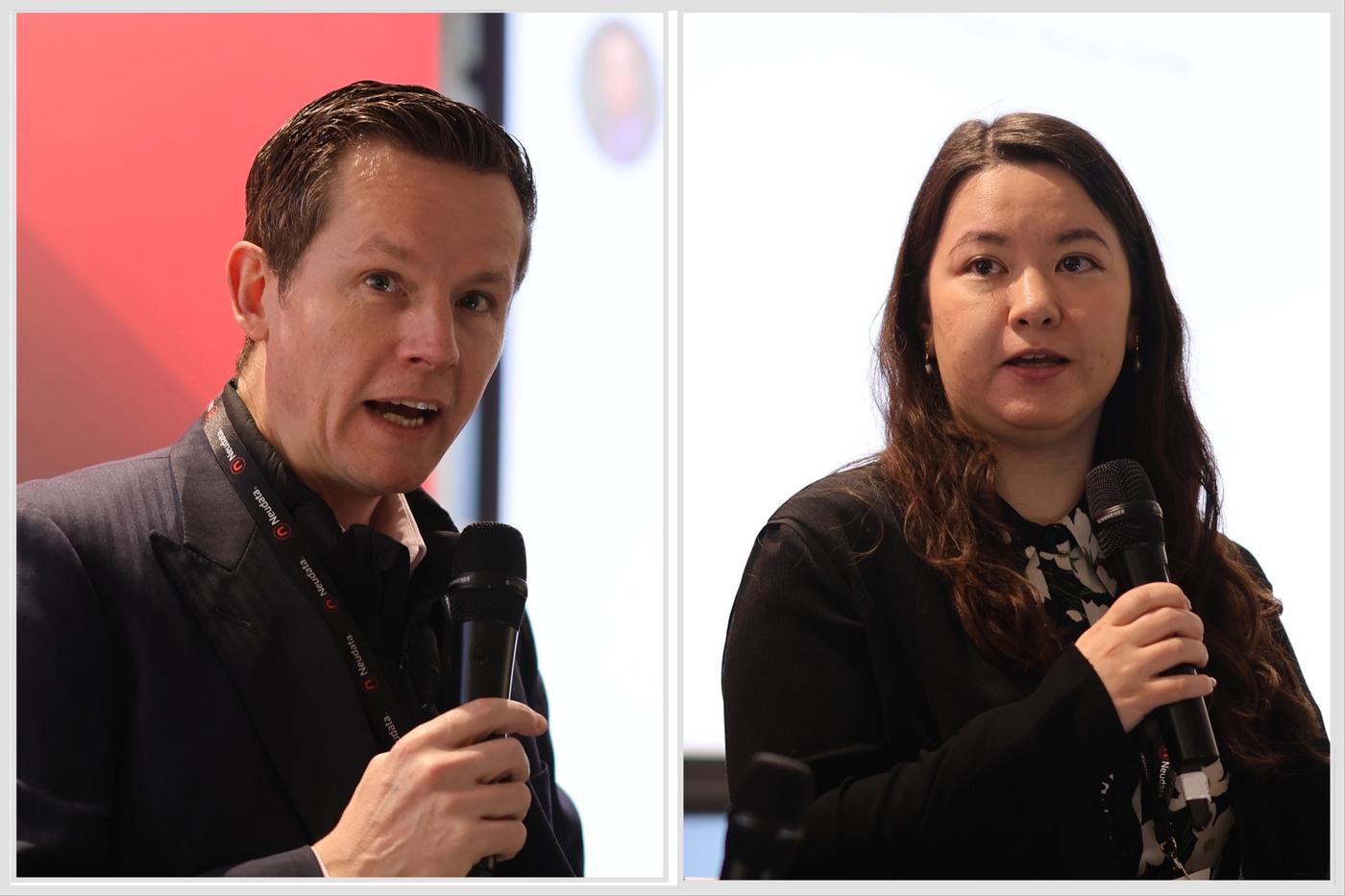
Paul Walsh (Morgan Stanley) and Sophie Beland (Morgan Stanley)
They’ve done a lot of work to identify supply chain mappings for firms, and from that they could identify which firms could for example be positively (and negatively) exposed to specific themes. Over the current Iran war, they had already done work on scenarios, and were early on in creating a tracker for the Strait of Hormuz. More broadly, they have been creating structured datasets and in particular global ones as an output for their research. This also included conducted surveys to fill in gaps.
On GenAI, they had been using these tools for sometime in research, like ChatGPT, Claude for Finance etc. The diffusion of AI was changing how teams operate, change habits and working behaviours. Whilst some of it might be summarisation (glorified search engine), it also included more indepth tasks like automating some of the work they have following oil markets. It could free up time, for analysts to speak to people in their networks, and other high value tasks.
Quantifying Global Trade Disruption
Greta Farina (LGIM) chaired a sessions on trying to understand how to model the economy in light of the disruption in global trade. The panel kicked off with a question about how to look at geopolitical shocks. Didier Borowski (Amundi) noted that you need to have geopolitical factors as an input into forecasting. Last year, people had expected global trade to collapse, but instead it has expanded, as geopolitics pushed countries to generate new trade flows, to offset the pressure. He noted how alt data could be complimentary, and he liked to deep dive into micro data. Without that you miss themes. It was also important to be aware of non-linearity in markets, for example looking at bond yields and their relationship with debt metrics, like debt-to-GDP. Since 2025 there has been a new relationship.
Lasse de la Porte Simonsen (Macrosynergy) noted the importance of using point-in-time data and drew a distinction between a forecast and a consistent backtest. Without point in time data, a forecast could have hindsight bias. Whilst Mabrouk Chetouane (Natixis) was not using alt data in his macro model, he did say it can be used to track turning points, especially on a short term bias. All central bank were investing in nowcasting now, he said, mixing together these dataset. It was important to know where we stand, and if don’t know, you cannot make the right decision. The task was very complex, and involved combining different frequencies and datasets together. We were seeing a resurgence in macro volatility like in the 1980s.
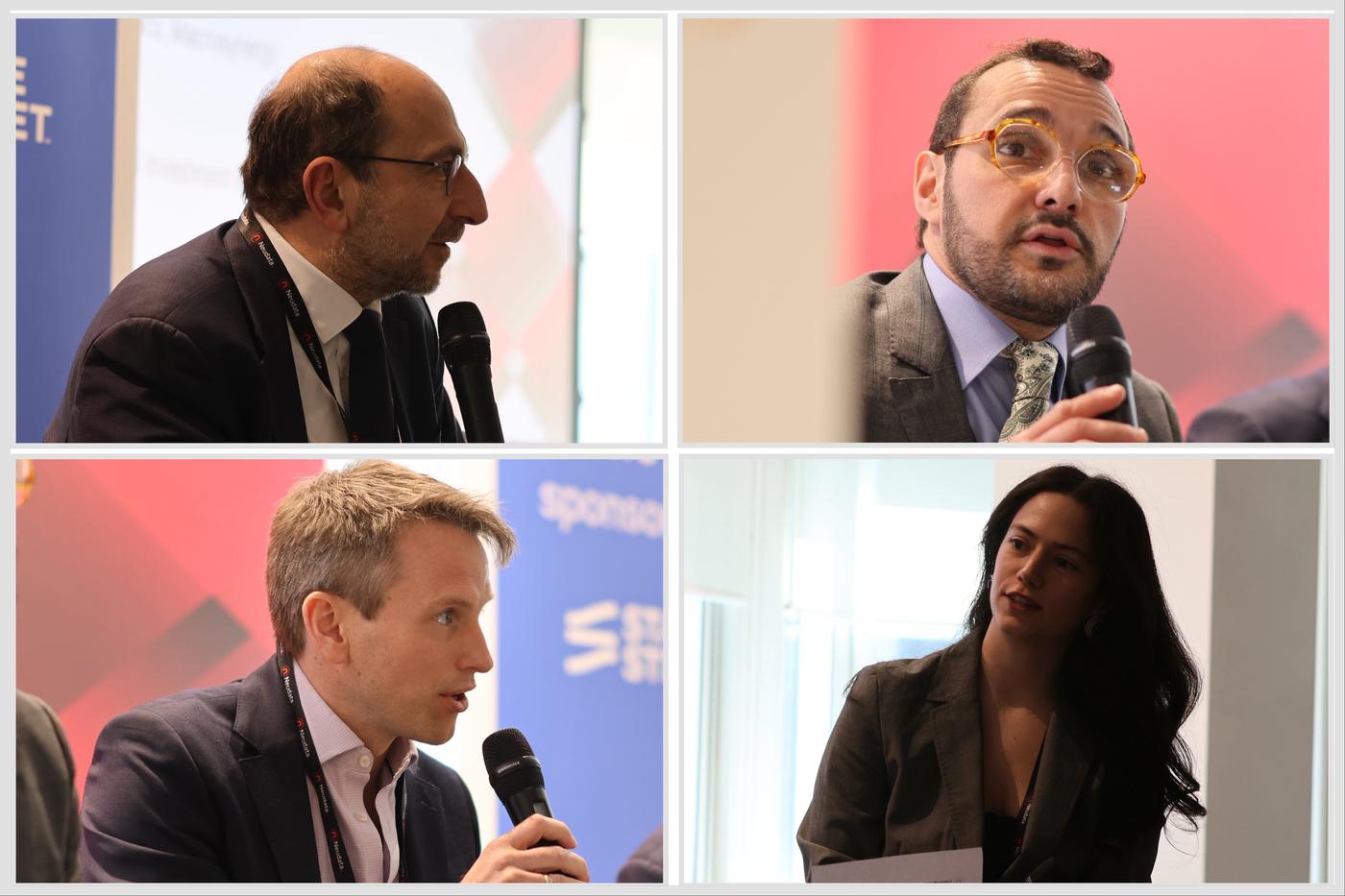
Didier Borowski (Amundi), Mabrouk Chetouane (Natixis), Greta Farina (LGIM) and Lasse de la Porte Simonsen (Macrosynergy) – clockwise
Data sourcing and vendor engagement: Trends and best practices in 2026
With the burgeoning number of datasets available, the role of the data strategist/data scout has grown in many hedge funds. They act at the bridge between internal investing teams and external data vendors. The task of managing these relationships can be very complex. Mark Fleming-Williams (CFM and host of the Alternative Data Podcast, which I do recommend) moderated a panel discussing how data strategists were tackling the role in 2026, with panellists Abigail McInnes (Man Group), Abhijeet Gaikwad (Agami), Eugene Miculet (WorldQuant) and Ben Cohen (Final).
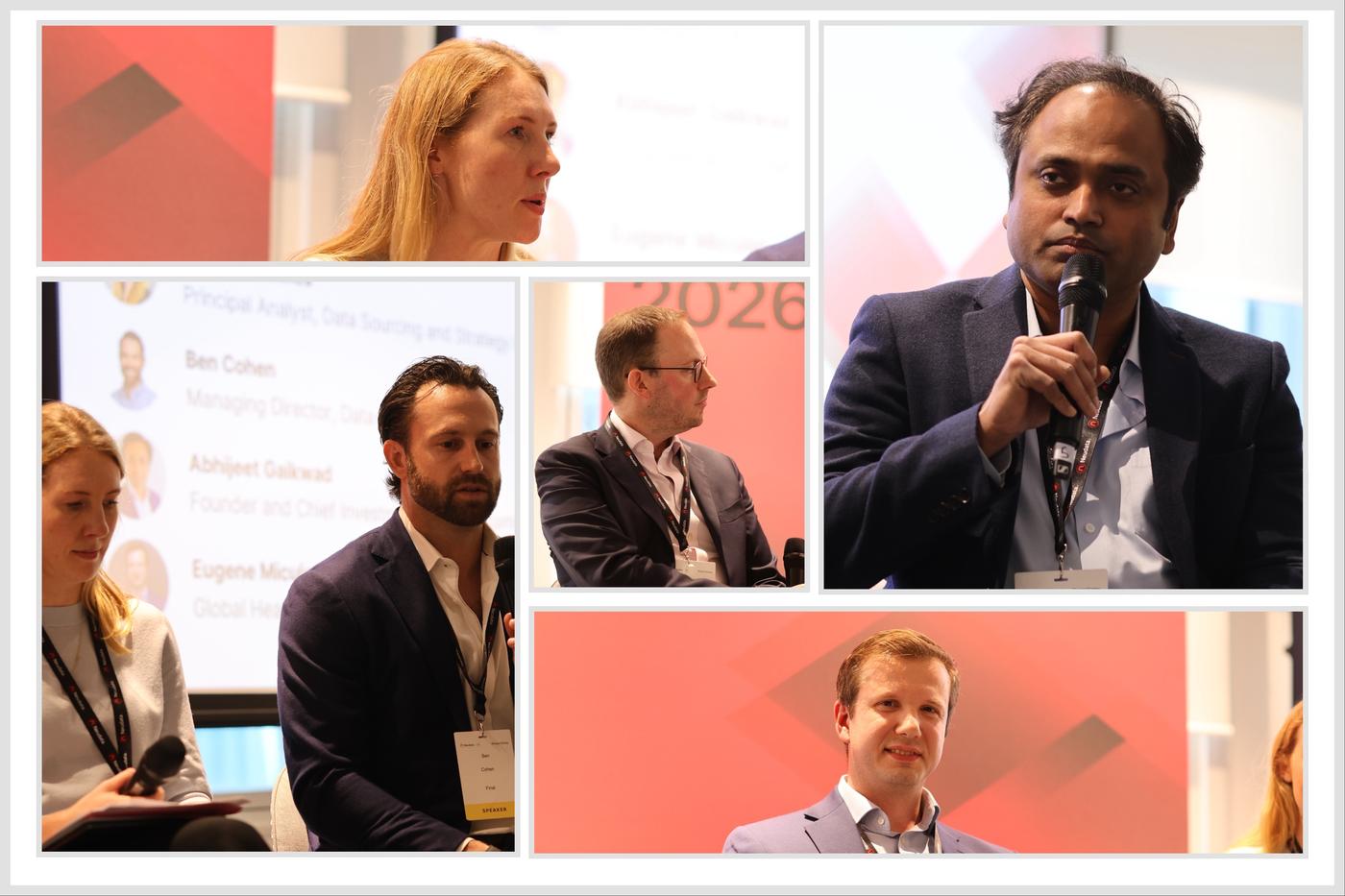
Abigail McInnes (Man Group), Abhijeet Gaikwad (Agami), Eugene Miculet (WorldQuant) and Ben Cohen (Final) – clockwise, and Mark Fleming-Williams (CFM) – centre
Abigail McInnes (Man Group) discussed how over the years her firm had developed a process around data, such evaluation and managing these processes, and professionalising the whole pipeline. She used a term of data portfolio manager as a way of conveying it. If you didn’t automate things, you could end up drowning in datasets.
Mark Fleming-Williams (CFM) asked how AI had impacted the data market. You could say that at least for quant funds, they were mostly after raw data. In a sense, anything a vendor was using AI for, a quant fund should be doing. In some instances, there was no history (or at least out-of-sample) for certain AI generated datasets, which were being collected from now onwards.
Ben Cohen (Final) talked about how automation could be used to find new data sources with AI tools, essentially automating the top of the data sourcing funnel. This freed up more time for deeper work. He wanted to think about what was driving his end clients, what do they care about when it came to investing. He liked to think of datasets, like a portfolio of assets, asking questions like why some signals were not working. Along this same theme, Abhijeet Gaikwad (Agami) talked about how he viewed data in terms of understanding the maximum returns versus costs. These costs included legal costs, opportunity costs etc. and they could be managed. However, the way that a data vendor viewed costs was different, ultimately for them it was a gross alpha. On the AI side, he cautioned that some vendors were using LLMs in an in-sample way. Eugene Miculet (WorldQuant) said that AI had been helpful for data vendors in terms of their go-to-market, such as creating documentation and data dictionaries around their products.
I also asked a question to the panel asking about push and pull when it came to data. How much data was pushed externally from data vendors, and how much data was pulled by the data strategists from the outside world. Figures ranged from 70%/30%, whilst others were 50%/50%. The conclusion however, was that ultimately it was a mix.
Conclusion
A lot has changed over the years in alt data space. I remember playing with interesting and exciting datasets at Lehman Brothers, twenty years ago, like news data. At the time, it was very novel. However, over the years alt data has percolated through more of the industry. At the same time, demand for the data has also grown more broadly. Neudata has obviously been part of this, bringing knowledge of alt data to the investment community over the past decade. It will be exciting to see what happens to industry over the coming years.