
The shock has already landed
Despite conflicting announcements about whether the Strait of Hormuz may close, vessel traffic remains underwhelming and supply concerns persist. Even if the chokepoint reopens quickly, shipping backlogs would take time to clear, keeping pressure on supply.
The inflation shock is already moving through consumer prices along two broad channels. The first is a direct energy channel, where crude oil, refined fuels, natural gas, and LNG affect prices almost immediately. The second is a slower commodity channel, where energy-intensive inputs raise the cost of producing and transporting food, manufactured goods, and industrial materials.
What moves through Hormuz
The Strait carries crude oil that helps set global oil prices, along with refined products such as diesel, jet fuel, naphtha, and fuel oil. It also ships LNG from Qatar, which accounts for roughly 20% of global LNG trade and is especially important for European and Asian gas pricing.
Beyond oil and gas, Hormuz-linked disruptions affect energy-sensitive commodities: ethane and naphtha used in plastics and synthetic fabrics; ammonia, urea, and sulfur used in fertilizer; industrial materials such as aluminum and some steel inputs; and smaller but important products such as helium and asphalt components.
Four paths from Hormuz to consumer prices
The price shock reaches consumers through four main channels, each on a different timeline.
- Energy prices (immediate)
Crude oil flows directly into gasoline prices, diesel into transport fuel, and natural gas and LNG into electricity and heating costs. These prices move quickly with disruptions, buffered only by available inventories.
- Transport and shipping costs (1 to 3 months)
Higher diesel and jet fuel prices raise the cost of trucking, shipping, rail, and air travel. Businesses may absorb some of these costs initially, but they typically pass through to consumer prices within one to three months.
- Food prices (6-12 months)
Food is the slowest and most complex channel. Higher energy prices raise the cost of fertilizer, farm fuel, and grain transport. Because food production depends on planting, harvesting, processing, and distribution cycles, these costs reach consumers with a lag. Cereals are affected first through fertilizer and shipping costs, while meat and dairy follow later through animal feed and farm operating expenses.
- Manufactured goods (6 to 12 months)
Oil-derived chemicals affect plastics, textiles, and clothing. Aluminum and other industrial inputs feed into cars, packaging, and machinery. Higher factory energy costs also lift production costs across manufacturing.
How exposed is each country?
We grouped CPI baskets across 36 regions into four areas most likely to be affected by a Hormuz disruption: energy, transport, food, and manufactured goods (Figure 1). The results show that exposure differs widely across regions, both in how large the impact could be and how quickly it may appear.
Figure 1
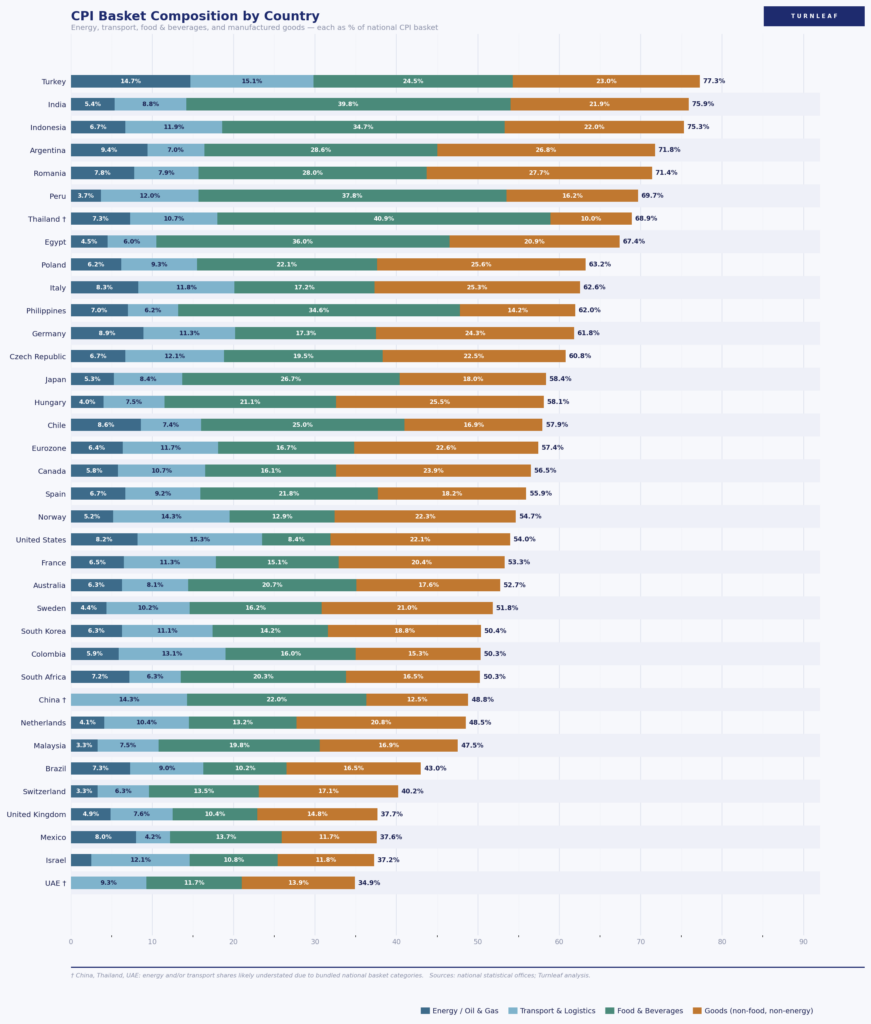
The chart shows that the Hormuz shock will not look the same everywhere. Turkey, India, Indonesia, Argentina, and Romania have the largest combined exposure, with more than 70% of their CPI baskets tied to these channels. Turkey is especially exposed through energy and transport, making it vulnerable to near-term increases in fuel, utilities, and freight. The United States has lower food exposure but one of the highest transport shares, so the impact is more likely to appear through gasoline, airfares, logistics, and delivery costs. By contrast, India, Thailand, Peru, Egypt, and the Philippines are more exposed through food, where price increases may arrive later but carry greater social and political weight because food represents a larger share of household spending.
This has important policy implications. A lack of immediate food inflation should not be read as evidence that the shock has passed. Countries with high energy and transport weights are likely to feel the first wave, while countries with large food baskets may face a longer inflation tail as fertilizer, crop cycles, transport, and retail pricing adjust.
Food prices: the delayed channel
The food sub-category chart shows why composition matters. Countries with large food baskets are not equally exposed: cereals are more directly affected by fertilizer, diesel, and grain-shipping costs, while meat and dairy face slower pass-through through animal feed and farm costs (Figure 2).
Figure 2
To read the rest, visit our latest Substack post, here.