
Late last night (April 7, 2026), the U.S. and Iran agreed on a two-week ceasefire to allow for diplomacy. During this time, Iran has agreed to coordinate the passage of vessels through the Strait of Hormuz. News of the ceasefire pushed Brent Crude futures back down to $90/barrel, relieving mounting price pressures. However, supply constraints are unlikely to ease quickly, keeping prices well above the $70/barrel baseline long enough for inflationary pressures to persist.
In an earlier post, Turnleaf explained that while the oil futures curve contains information about conditions in the oil market, it does not map directly onto inflation. Prices across maturities reflect not just current scarcity, but also the market’s changing assessment of future supply conditions, replacement costs, and geopolitical risk.
Inflation, however, tends to outlast the initial oil shock. Even after crude prices retreat from their peak, the effects continue to pass through freight, food, industrial inputs, and regulated prices. Exchange rate fluctuations during the conflict put pressure on imports. That is why a front-loaded oil shock can still generate a slower-moving and more persistent inflation cycle.
To understand the future path of inflation, it is essential to track how changes in global oil prices pass through to retail fuel prices. Turnleaf’s daily Fuel Indices provide a direct measure of how disruption in global oil markets is being transmitted into pump prices across countries, making them a useful gauge of near-term inflation pressure.
The indices also show that pass-through varies significantly across markets, reflecting differences in policy intervention, taxation, and pricing structures. While some countries are attempting to cushion the impact, the underlying cost shock is still being transmitted to end users to varying degrees. In the table below, we combine country-specific policy responses with changes in Turnleaf fuel indices, Brent crude prices, and exchange rates to estimate pass-through to consumers.
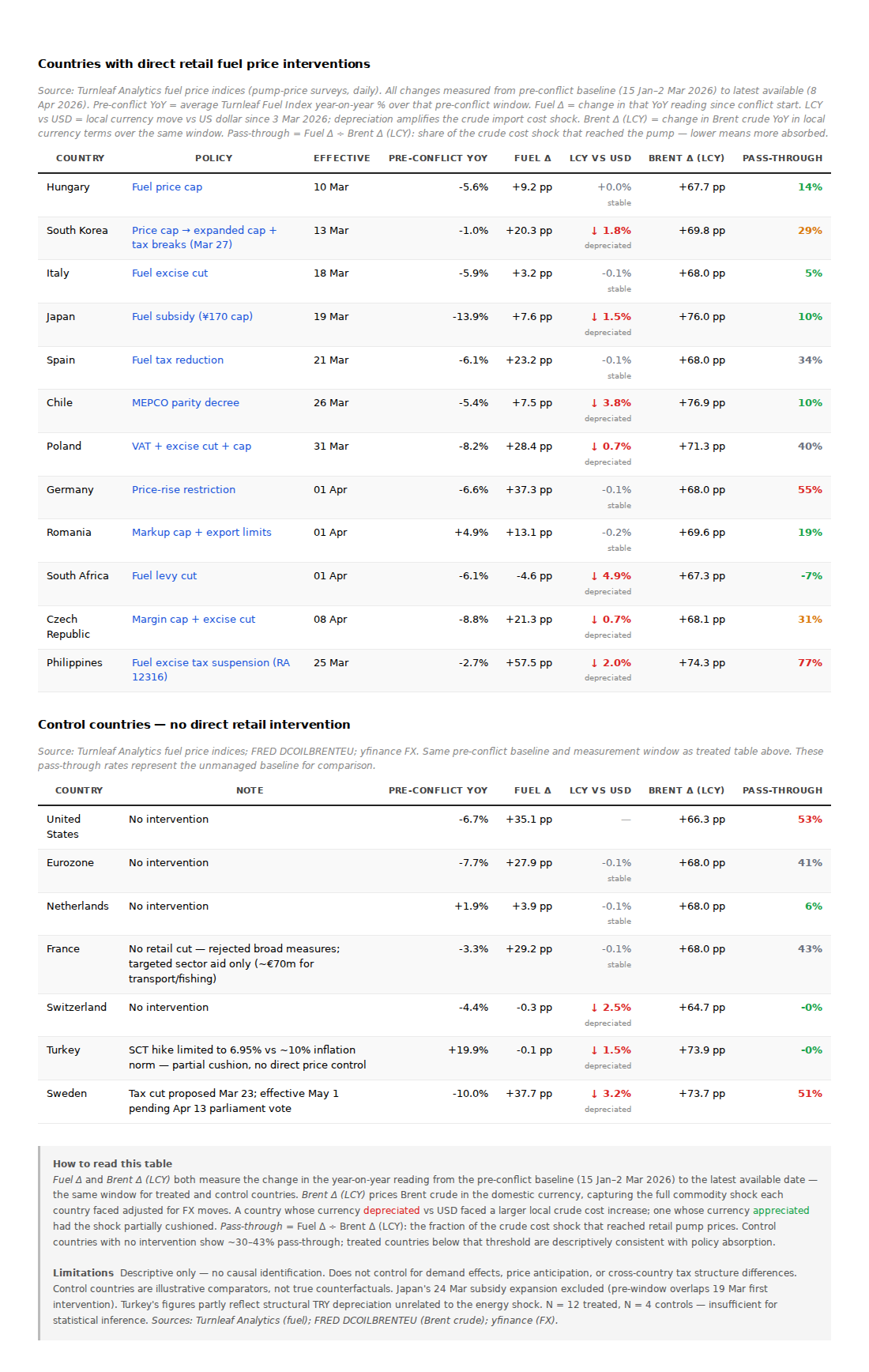
Turnleaf Fuel Indices provide a forward-looking framework for assessing inflation risk in the current environment. By capturing both the speed and extent of fuel price adjustment across markets, they offer a consistent basis for monitoring how this ongoing shock is feeding into broader macroeconomic pressures.