
The oil shock has entered a more complicated phase. Since late February, when the US and Iran conflict began, shipping through the Strait of Hormuz has been severely restricted, cutting the majority of normal Gulf export flows. That disruption constrained the principal export route for Saudi Arabia and other Gulf producers, but it did not restrict every route out of the region. Saudi Arabia has been redirecting production through the East-West Pipeline to the Red Sea port of Yanbu, while the United Arab Emirates has continued to load crude at Fujairah, which lies outside Hormuz on the Gulf of Oman. Together these alternative routes offer an estimated 3.5 to 5.5 million barrels per day of spare export capacity (Figure 1), according to IEA estimates.
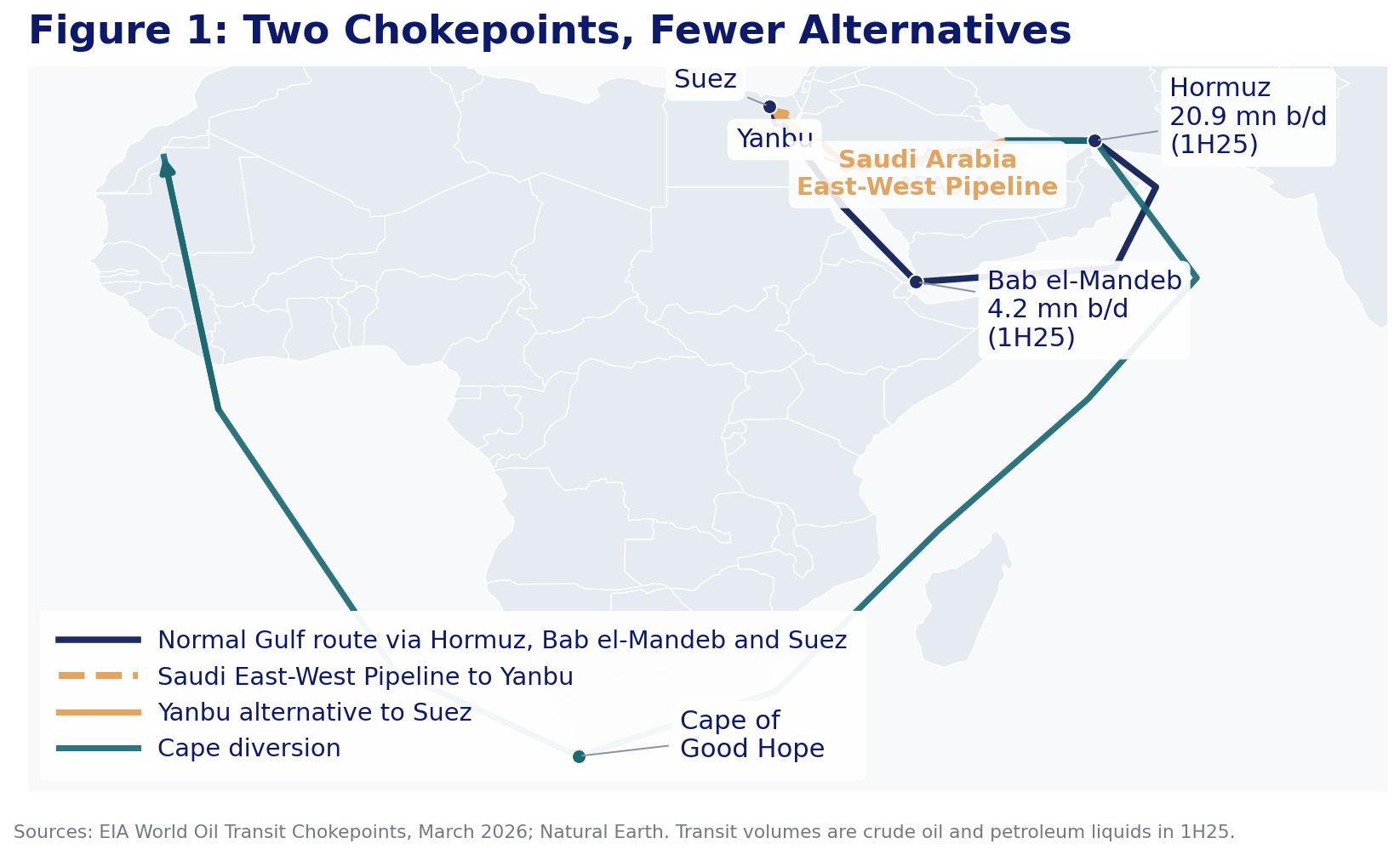
The Houthi announcement is specifically framed as a maritime embargo against Saudi shipping in the Red Sea, and a full closure of Bab el-Mandeb to all traffic has not materialised. Even so, the announcement directly weakens Saudi Arabia’s Red Sea route around Hormuz. The UAE’s Fujairah route remains available for exports to Asian markets. From here the risk splits into three scenarios. In the current situation, Saudi shipping is targeted but wider transit continues. An escalation scenario would involve attacks or insurance withdrawal disrupting broader Bab el-Mandeb traffic. An extreme scenario would see the strait become effectively inaccessible for most cargoes.
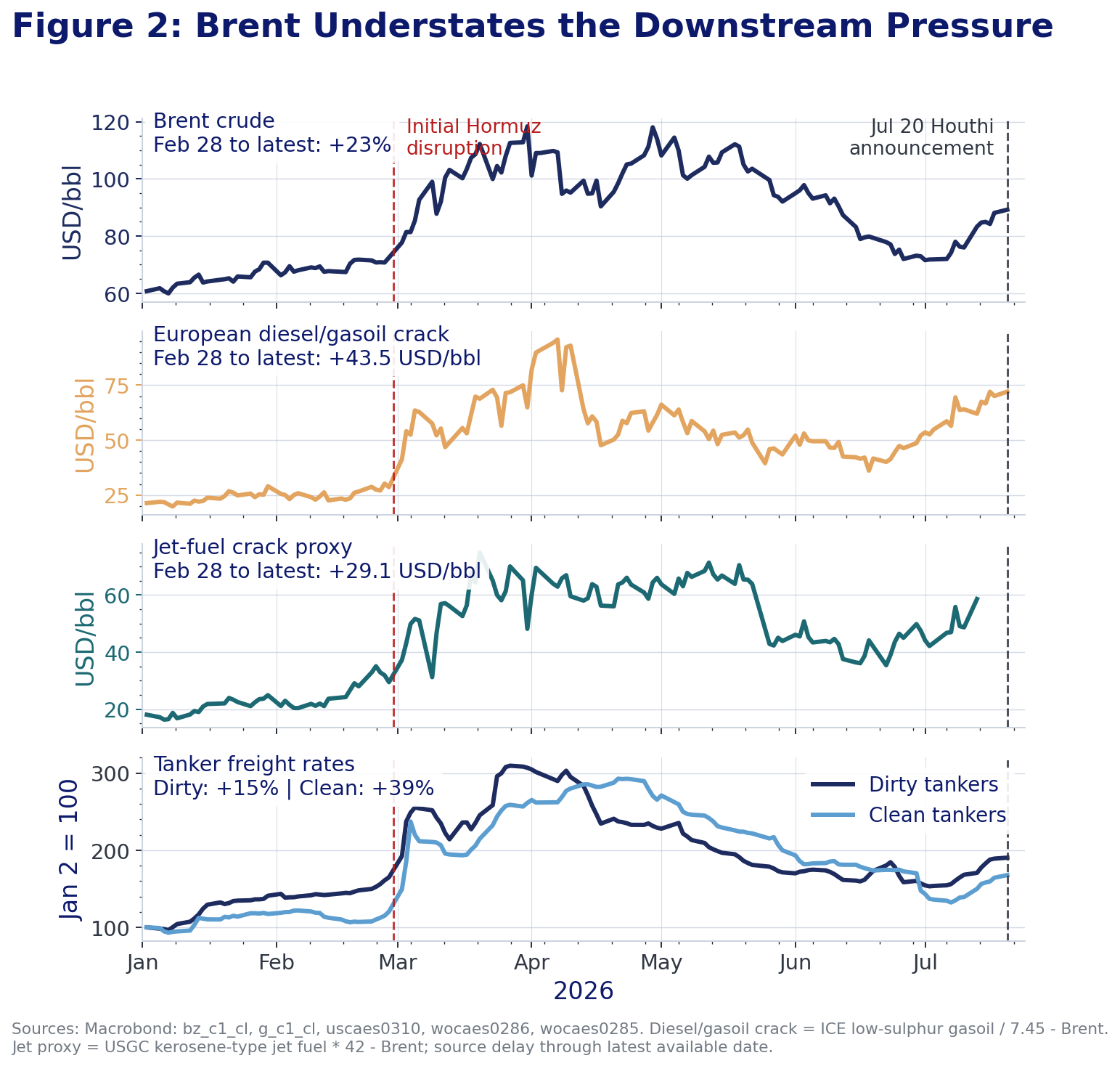
Brent closed at $89.22 per barrel on July 20 after the announcement (Figure 2), but the larger inflation risk lies in delivery constraints. If the disruption delays crude and refined products, the effective cost of energy can rise even without a comparable increase in the benchmark oil price.
More than 3 million barrels per day of Saudi crude is currently being loaded at Yanbu, much of it destined for Asian markets. These volumes remain dependent on passage through Bab el-Mandeb. Where Cape rerouting remains operationally possible for cargoes that continue to transit the strait but avoid the Suez route, one-way voyages may lengthen by roughly one to two weeks depending on origin, destination and vessel speed, absorbing effective tanker capacity and leaving refiners more dependent on inventories or replacement cargoes. If Bab el-Mandeb itself becomes inaccessible, however, Yanbu exports to Asia would be directly constrained rather than merely delayed.
The downstream pressure may be more visible in refined-product margins and tanker freight rates than in Brent alone. European diesel refining margins were already close to $65 per barrel following the Houthi announcement, and the jet-fuel crack proxy has risen by around $29 per barrel since late February (Figure 2). Clean-tanker freight rates, which price the movement of refined products, are up 39 percent over the same window against a 15 percent rise for dirty tankers, consistent with tighter product markets than crude and pointing to stronger pressure in the fuels that feed most directly into transport costs and consumer prices.
Asia is the most directly exposed region. Around 80 percent of all oil volumes transiting Hormuz are destined for Asia. Within the crude component, China and India together received 44 percent of Hormuz crude exports in 2025. Japan and South Korea also remain heavily dependent on Gulf supply. Only around 4 percent of Hormuz crude flows directly to Europe, although Europe remains indirectly exposed through globally traded refined products, freight and the reallocation of cargoes. In an escalation scenario that extends disruption from Hormuz into Bab el-Mandeb, Asian refinery supply, shipping schedules and energy-import bills would be hit first.
Higher import costs could also weaken regional currencies, amplifying the local-currency price of dollar-denominated oil. The shock would then spread through electricity, transport, chemicals, plastics and industrial production. Subsidies, tax cuts and administered fuel prices can delay the CPI impact, but they shift the cost to public finances or state-owned energy companies rather than remove it.
Europe is less exposed to Gulf crude directly, but more vulnerable to refined fuels and disruption along the Asia-Suez trade route. Diversions around the Cape of Good Hope would extend delivery times, absorb shipping capacity and raise the landed cost of manufactured goods and intermediate inputs. The initial impact is likely to appear in diesel, freight and import prices, followed later by consumer goods as inventories are replenished.
Latin America faces a particularly difficult policy trade-off
To read the rest, visit out latest Substack post here.