
To gauge how markets are pricing the durability of the current US-Iran ceasefire, we aggregated conflict resolution probabilities across four prediction market platforms (Polymarket, Kalshi, Metaculus, and Manifold Markets), encompassing over $470 million in total trading volume. We constructed a composite probability curve measuring the likelihood of a lasting end to hostilities at each date through December 2026, defined as 14 or more consecutive days without qualifying military action between Iran and the US/Israel coalition (Figure 1, top panel – visit our Substack to see the figure).
We then compared this probability curve with the NYMEX WTI oil futures prices from May through December 2026, based on April 8–9 settlement prices (Figure 1, bottom panel). We modelled two scenarios that bracket the range of outcomes – a peace path converging to Goldman Sachs’ Q4 base case of $67 and a re-escalation path returning to $110–118 – and weighted them by the probability of each outcome at every point in time.
The top panel shows that markets assign very low near-term credibility to the April 7 ceasefire but grow more optimistic over time, in line with the Islamabad negotiating track. The probability of lasting peace is near zero today, reaches only 8% by end of April when the ceasefire expires, and does not cross 50% until late June. The steepest climb falls between June and July, consistent with the view that a durable deal requires months of negotiation. Independent estimates from Metaculus (9% for ceasefire before May, 469 forecasters) and Kalshi (35% for a nuclear deal by 2027) sit close to the main curve at their respective dates, providing cross-platform confirmation.
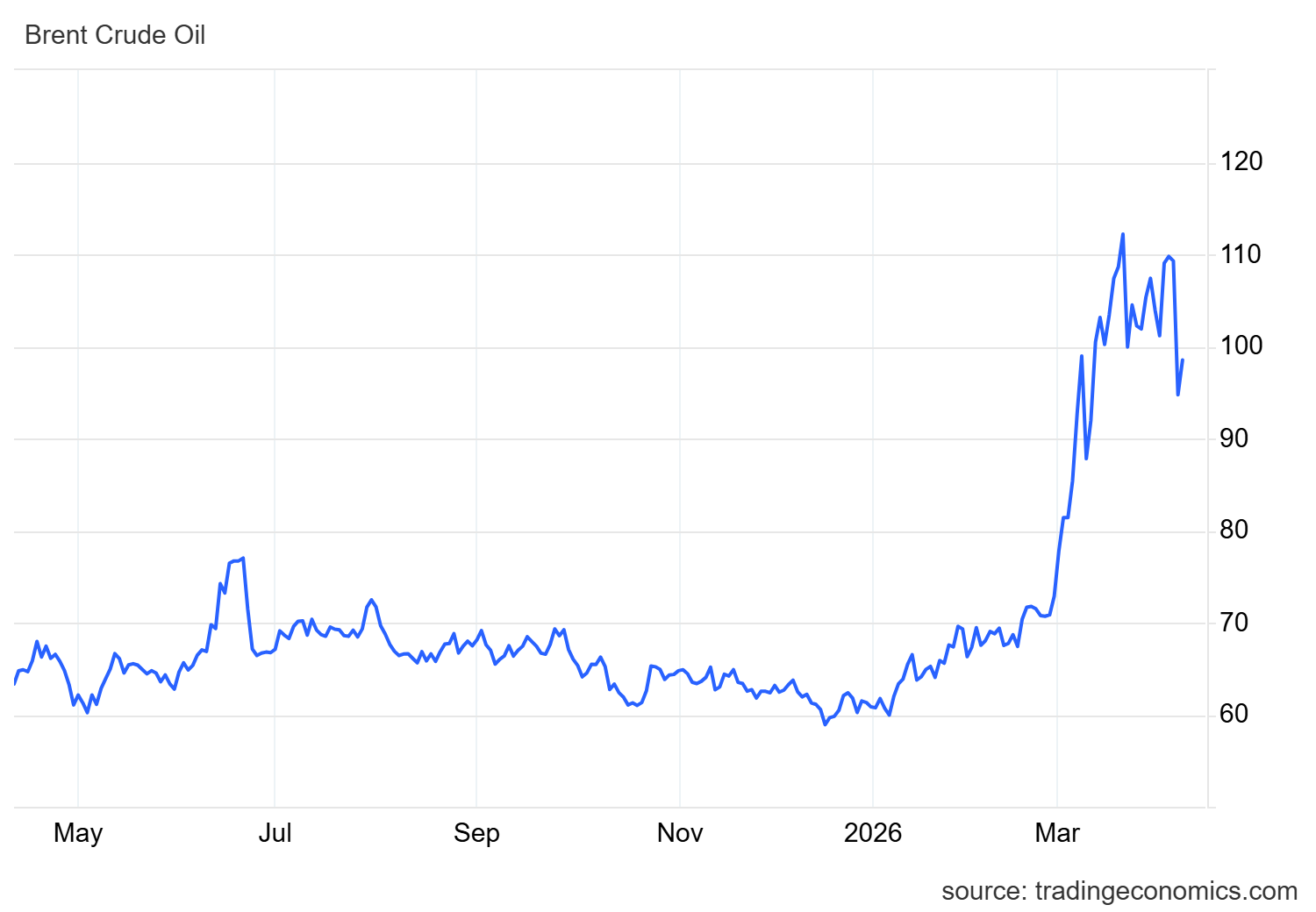
The bottom panel translates these probabilities into oil prices. Futures prices today slope steeply downward, from roughly $96–108 in May to about $72–74 in December. Our probability-weighted path remains above the futures curve throughout the period, although the gap narrows materially from late summer onward.
That gap is largest in the near months. At a minimum, it suggests that the futures curve is pricing a faster normalization in oil than our probability-weighted conflict framework would imply. Our model is deliberately simple. It maps political resolution probabilities into two oil-price paths, but it does not attempt to capture the full range of near-term market dynamics, including inventory positioning, shipping frictions, precautionary premia, or other temporary dislocations that can keep front-month prices elevated relative to a medium-term scenario model.
The sharp decline in the futures curve toward $72–74 by December therefore suggests that the market expects current tightness to ease over that horizon. That easing could come from some combination of supply normalization, weaker demand, or policy responses, but the figure itself does not identify which mechanism dominates. The key point is that the futures curve is answering a different question from the conflict-probability model. It reflects not only whether hostilities persist, but also how quickly any resulting oil-market disruption fades.
Even if peace is reached, the inflation impulse from an oil shock would not disappear immediately. Energy-price pass-through typically lags the underlying move in crude, especially in energy-importing economies. In that sense, any near-term disruption could continue feeding into headline inflation after the political situation has stabilized. At the same time, the top panel still implies roughly a 24% chance that the conflict has not durably ended by year-end, leaving meaningful upside risk to both oil and inflation beyond the central case.
Two caveats are worth noting. First, our peace-versus-escalation framing is deliberately simple. Real outcomes will fall on a spectrum that includes partial de-escalation, intermittent disruption, and sanctions easing without full normalization, any of which would produce oil prices between our two scenario bounds. The probability-weighted price should be read as an analytical anchor, not a point forecast. Second, the inflation discussion above is directional rather than mechanical. The timing and persistence of pass-through will depend not just on the path of hostilities, but also on the speed of supply normalization, domestic fuel-price policy, and the response of broader demand.
This material is produced by Turnleaf Analytics for informational purposes only and does not constitute investment advice, a recommendation, or an offer to buy or sell any security or financial instrument. The analysis reflects our interpretation of publicly available data as of the date of publication and is subject to change without notice. Readers should consult qualified financial, legal, and tax advisors before making any investment decisions. Turnleaf Analytics accepts no liability for losses arising from the use of this material.