
Turnleaf’s Mexico CPI nowcast for May 2026 is 4.04 percent YoY, slightly below Banxico nowcast of 4.09 percent YoY. Figure 1 shows a softer near-term profile, with the model close to Banxico consensus at the start of the forecast horizon. The path does not stay flat, however. The model moves above the Banxico forecast later in the horizon as fuel, trade-cost, and domestic-activity signals continue to add pressure.
Figure 1 – To gain access to Turnleaf’s Mexico 12-month forecast, visit our latest Substack post, here.
That does not mean the forecast is assuming a direct pass-through from Brent or other global fuel benchmarks. Mexico’s fuel-price smoothing framework, including IEPS relief and administered-price adjustments, is already reflected in the model and limits the near-term energy impulse. The remaining upside comes from the portion of fuel pressure that still reaches domestic prices, along with the Mexico Leading Indicator and medium-horizon traded-goods inputs. The Mexico Leading Indicator is a composite measure that tends to anticipate Mexico’s economic cycle, making it relevant for services and core inflation pressure. These upside pressures are partly offset by selected food inputs, tomato prices, seasonality, core momentum, and lower risk-news readings.
Global fuel indicators are being flagged by our model because they capture upstream cost pressure that can reach Mexico before it is fully visible in local retail fuel prices. The smoothing framework limits direct pass-through into pump prices, but global crude prices, refining margins, import costs, and freight conditions can still affect the cost of supplying and distributing fuel domestically. Recent supply and distribution risks, including Pemex’s Q1 2026 net loss and the discovery of fuel-theft infrastructure, are examples of why local fuel conditions can amplify or transmit those upstream pressures through the domestic system. Some of that pressure can later appear in domestic pump prices, transport costs, distribution margins, or traded-goods prices. In that sense, Brent is not being treated as a direct CPI input. It is an early signal of fuel-related cost pressure that may pass through Mexico’s policy and supply channels over time.
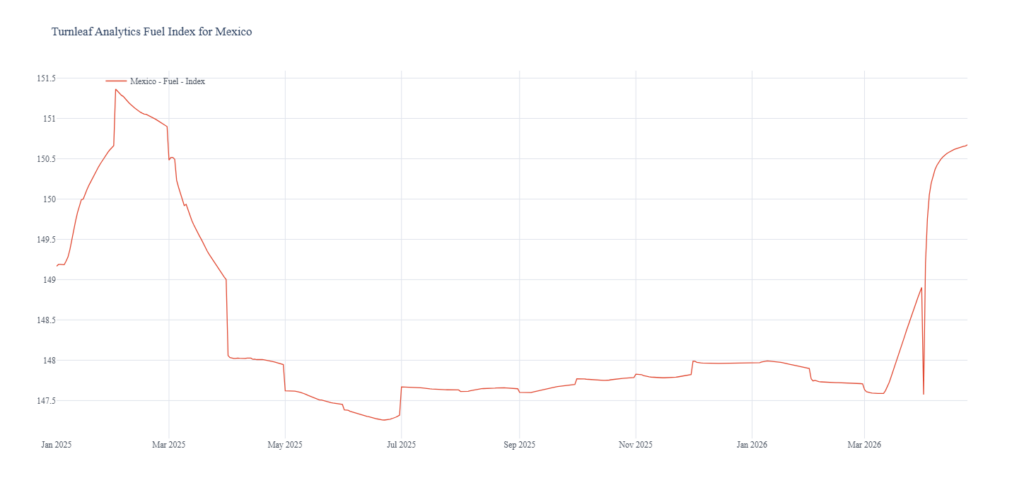
Our proprietary Mexico Fuel Index helps show how much upstream fuel pressure is reaching domestic prices (Figure 2). After declining and then remaining broadly stable through much of 2025, the index has turned higher in the latest observations. That suggests fuel-related pressure has not been fully absorbed by policy smoothing and remains relevant for near-term CPI through the fuel category, transport costs, and distribution costs over the next 1–4 months.
Figure 2
Broader commodity and trade signals should be read the same way. OECD Cotton and the Global Supply Chain Pressure Index detected by our model as relevant are not included as generic global-market proxies. They are flagged because they capture cost pressure that can reach Mexico through imported goods, freight, inventories, distribution costs, and retail-price resets. These channels tend to move more slowly than fuel, so their contribution is more important in the middle and later parts of the 12-month forecast.
FX and equity-market inputs are also interpreted through Mexico-specific channels. The model is not assuming that strong U.S. equities or broad global risk appetite automatically raise Mexico inflation. Those variables would need to translate into a weaker peso, stronger local demand, higher freight costs, higher import prices, or firmer local goods prices before they would add to the CPI forecast.
Turnleaf expects fuel smoothing and several domestic offsets to keep the near-term profile softer, but not flat over the full 12-month horizon. Selected food inputs, tomato prices, seasonality, core momentum, and lower risk-news readings are offsetting part of the upside pressure. At the same time, fuel-related pressure is still visible in domestic prices, domestic activity remains an inflationary input, and trade-related cost pressures continue to feed into the forecast beyond the first few months.