
Euro area inflation rose to 3.2% YoY in August from 2.9% in July, with energy contributing 1.29 percentage points to the annual rate, according to Eurostat. The ECB’s September staff projections put the peak at 3.6% in the fourth quarter of 2026 and inflation at 2.5% by the second quarter of 2027. With energy already accounting for more than a percentage point of headline inflation, the path from wholesale fuel markets to retail prices can determine whether inflation peaks in the fourth quarter or continues rising into early 2027.
Turnleaf’s 18 September forecast implies a stronger and more persistent inflation path than the ECB’s September baseline. Our curve moves above 4% by November, peaks above 4.5% in January and February 2027, and remains near 4% through August. The forecast gap comes from downstream energy transmission: how long regional product margins remain elevated, how much of the wholesale move still has to reach the pump, and when temporary price support expires.
Figure 1. Turnleaf euro area CPI forecast curve by vintage, against realised. (to read gain access to the Eurozone forecast please visit our latest Substack, here)
Regional Product Prices Carry the Inflation Signal
The ECB already incorporates higher refined-product prices, but its technical assumptions were fixed on 19 August. Product markets tightened further afterwards. The Amsterdam-Rotterdam-Antwerp diesel crack reached a record $98/bbl on 1 September, versus an August average of $80.50 and $44.75 in June, according to S&P Global. Mediterranean ULSD also reached record levels in mid-September, according to S&P Global. Crude can therefore stabilise while the cost of the fuel sold to households remains elevated. Regional product margins capture that additional downstream pressure and are the more relevant input for the near-term fuel-inflation path.
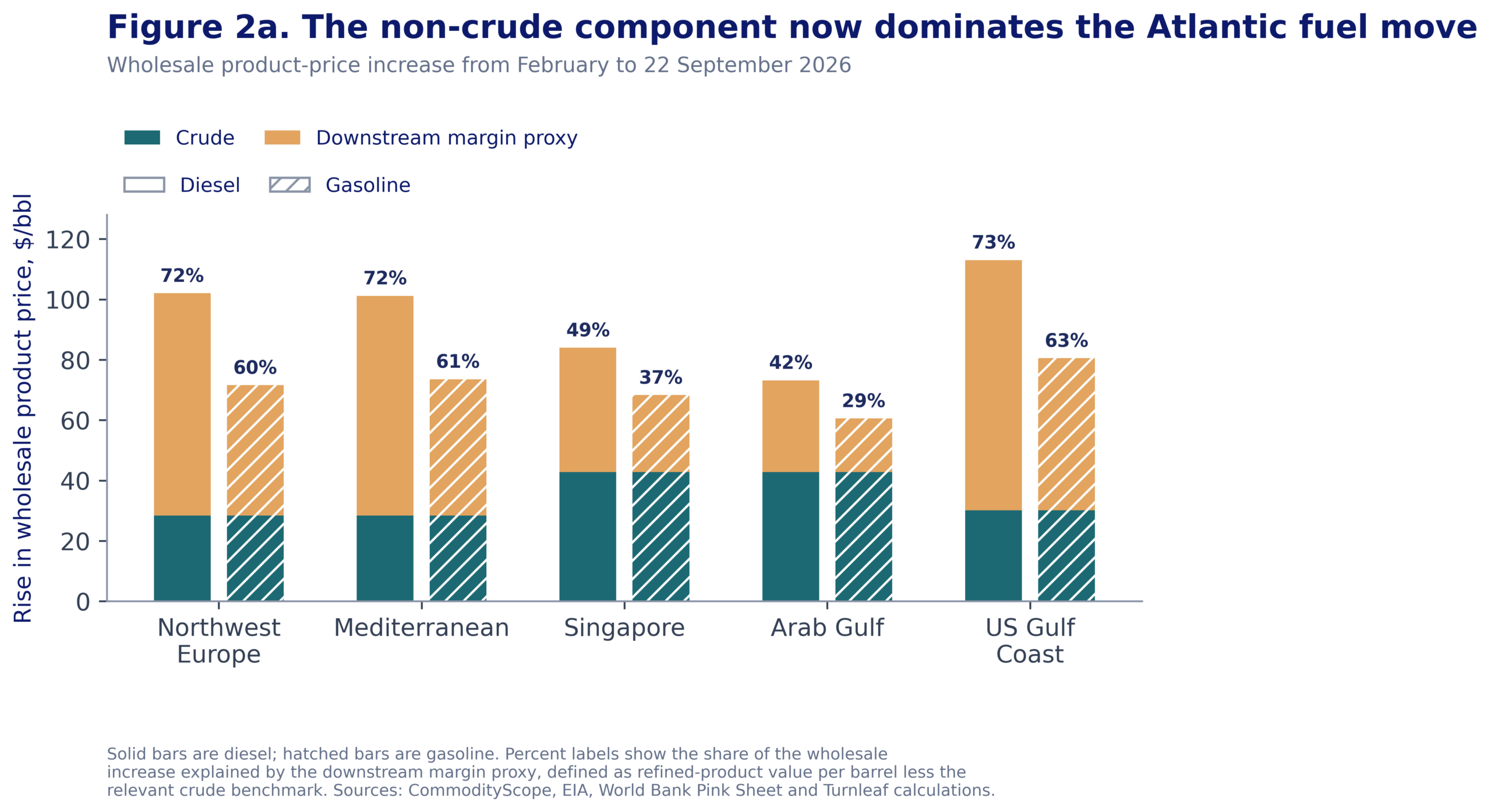
The non-crude component accounts for roughly 60-72% of the wholesale increase across the Northwest European and Mediterranean petrol and diesel benchmarks, and about 63% of the US Gulf Coast gasoline increase. Across Singapore and the Arab Gulf, the corresponding range is about 29-49%. Figure 2a measures this component with downstream-margin proxies defined as refined-product value per barrel less the relevant crude benchmark. France, Italy and Spain have petrol and diesel weights that are close to balanced, Germany is more gasoline-heavy, and the US is overwhelmingly gasoline-heavy. The direct CPI impulse therefore depends on which refined product is scarce and how heavily that product is represented in the local basket.
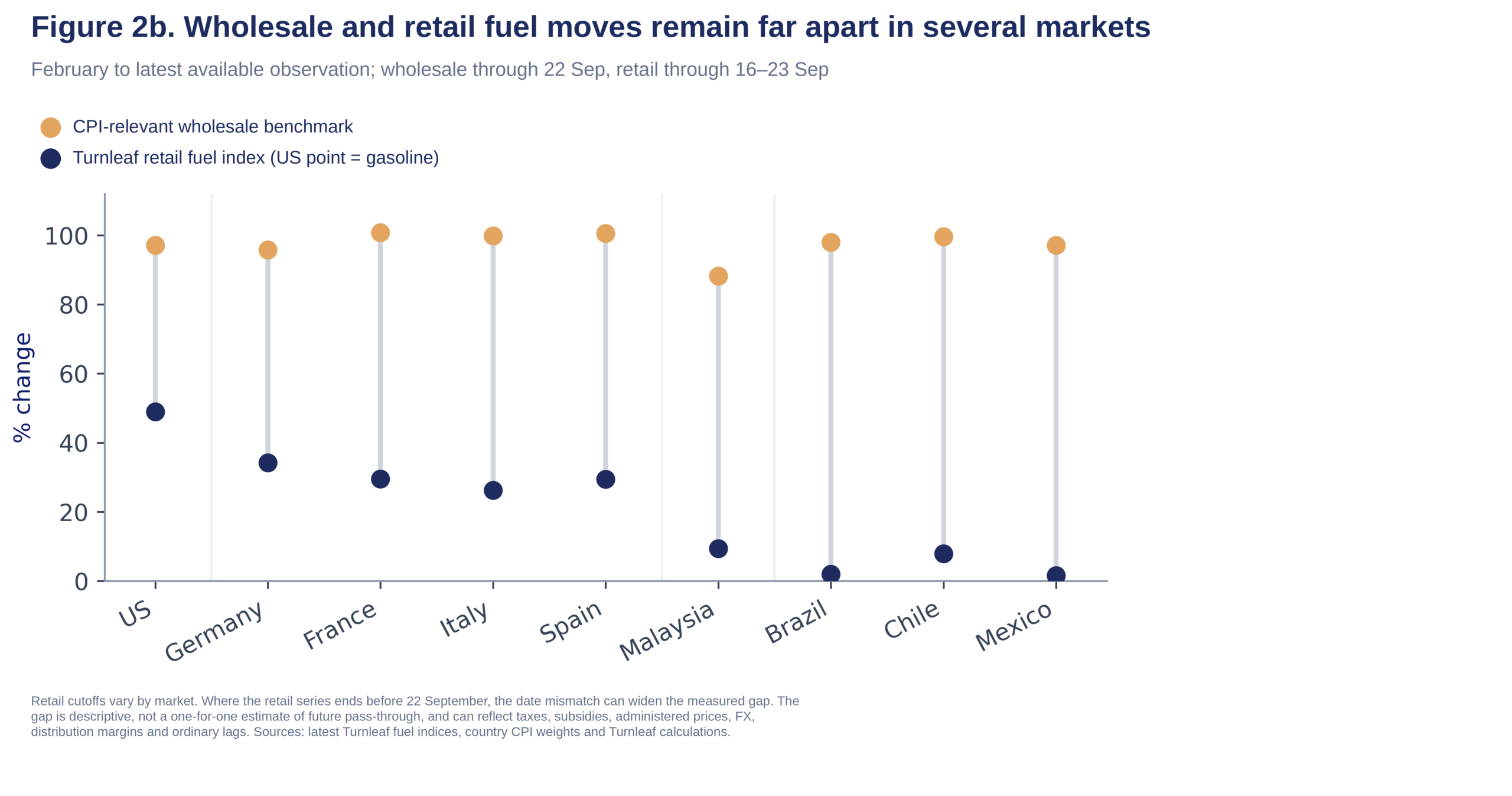
Using the latest Turnleaf dataset materially widens the current wholesale-retail comparison. From February to the latest September observation, the US retail gasoline index is up 48.9% against a 97.1% wholesale gasoline benchmark move. Germany is up 34.2% against a 95.7% CPI-weighted wholesale signal; France 29.5% against 100.7%; Malaysia 9.4% against 88.2%; Brazil 2.0% against 98.0%; and Mexico 1.6% against 97.1%. These gaps show how much of the external move has appeared in observed retail prices. Their size also reflects taxes, subsidies, administered prices, FX, distribution margins and ordinary lags, which determine how quickly the wholesale shock reaches consumers.
The three layers answer different forecasting questions. Wholesale benchmarks measure external price pressure. The Turnleaf retail indices show how much consumers are already paying. Figure 3 isolates the fresh month-on-month retail move that can feed into the next official CPI release. Together, the three layers separate upstream pressure from realised retail inflation and the portion most relevant to the next CPI print.
The euro-area Turnleaf retail fuel index is currently up 3.8% month on month through 23 September. Germany is at 5.0%, France at 5.2% and US gasoline at 5.7%. At a liquid-fuel weight near 4% of the euro-area HICP basket, a 3.8% retail move is mechanically worth about 0.15 percentage point on headline inflation if it is fully mirrored in the official fuel index. That mechanical contribution covers part of the gap between the Turnleaf and ECB forecasts. Official sampling, compilation and incomplete pass-through will determine the realised contribution.
Price-Setting Rules Determine the Pace of Transmission
Excise changes, subsidies, caps and pricing formulas can keep the retail price below the wholesale benchmark for months. Germany’s government-approved package is intended to cut the energy tax on petrol and diesel by 14 cents per litre from 1 October through year-end, equivalent to about 17 cents including VAT. The accelerated legislative process was still due to conclude with Bundesrat approval on 25 September, according to the German government. If the relief takes effect as planned and expires at year-end, it can suppress part of the fourth-quarter pump-price increase and then create a mechanical upward step in January if underlying pre-tax prices are unchanged. That timing is directly relevant to why Turnleaf’s euro-area curve peaks in early 2027 rather than in the fourth quarter.