
Colombia’s 12-month inflation outlook for 2026 has been revised higher. We now expect inflation to hit up to 6.7%YoY by the end of the year (Figure 1). This is a clear break from the lower path implied before the minimum wage decision. The shift follows the 23% minimum wage increase by government decree, which is expected to add substantial upward pressure to prices. To understand this trend shift, we need to understand the minimum wage’s role in indexation and cost pass-through, particularly in services and regulated or administrative prices.
Figure 1 – See Turnleaf’s latest Substack post, here.
The Indexation Mechanism
In Colombia, an estimated 27.9% of the CPI basket is affected by indexation linked to the minimum wage (BBVA Research). At the same time, indexation doesn’t happen all in January, but is distributed across the year as prices adjust based on contract renewal dates, regulatory calendars, and annual reset clauses for items such as:
- Education/tuition (often adjusted around the academic cycle)
- Public utilities and other regulated/administered prices (often adjusted on scheduled reviews, which can be quarterly or semi-annual depending on the item)
- Service contracts (adjusted at various points throughout the year at renewal/reset dates)
- Government fees and fines (often updated at the beginning of the year or when the relevant administrative unit is updated)
- For urban housing leases, increases are typically capped by the prior year’s CPI and applied at contract renewal. That said, higher minimum wages can still affect housing-related services and maintenance costs via pass-through.
The minimum wage increase decreed by President Gustavo Petro on December 29, 2025, raised the base minimum wage to COP 1,750,905 per month, with a transport subsidy bringing the total to COP 2,000,000. This is one of the largest annual increases in recent decades.
Inflation Expectations Surge
Besides the minimum wage increase mechanically increasing a portion of indexed prices, inflation expectations have adjusted sharply (Figure 2).
Figure 2
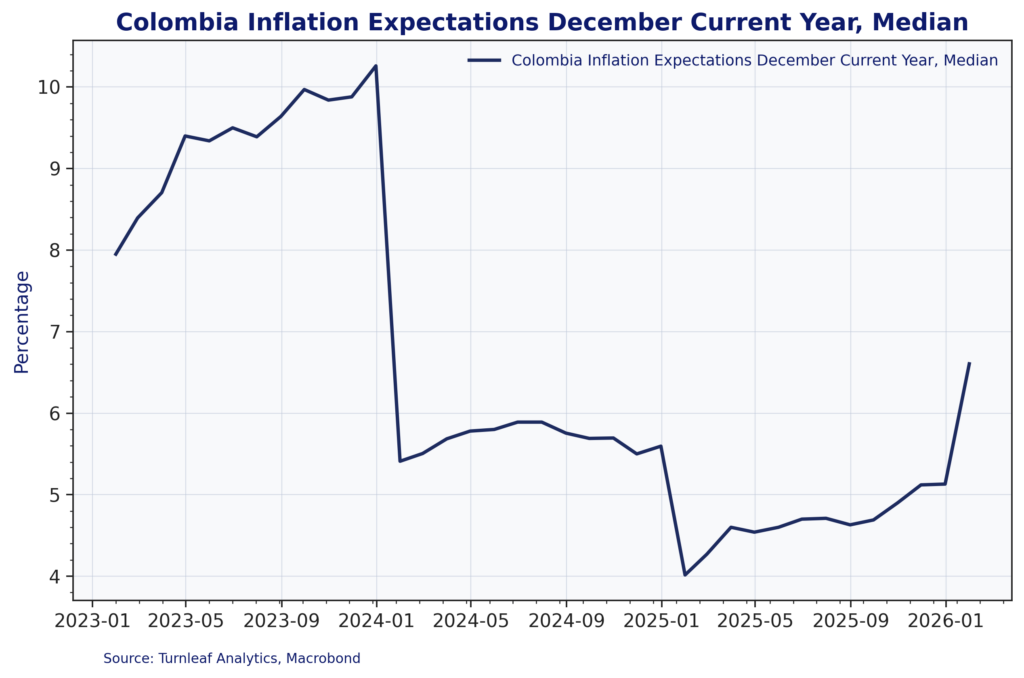
In the first central bank/bank-survey readings following the decree, economists raised their forecasts for end-2026 inflation to ~6.4% (Bloomberg reports ~6.37%, consistent with the central bank survey shift from ~4.6% to ~6.4%). Prior to the decree, Colombia’s central bank had projected ~3.6% inflation for end-2026.
Decoupling Efforts
It’s no surprise that after a minimum wage hike of this magnitude, the government has also begun to discuss how the country can reduce automatic linkages between the minimum wage and certain prices to prevent additional price pressure. Petro has discussed “deindexing” some regulated/administered prices and administrative charges from the minimum wage and instead adjusting them based on annual inflation or other criteria.
Critically, public transport and other wage-intensive, regulated or administered services can face higher cost pressure after a large minimum wage increase, and those increases can ripple through the economy via logistics and distribution costs. A reversal toward a downward inflation trend is likely only in 2027, especially if further minimum wage increases are much lower than that of 2026.
Currency Appreciation vs. Price Pressures
Though Colombia benefited from peso appreciation versus the dollar in late 2025, uncertainty continues to strain the outlook (Figure 3).
Figure 3
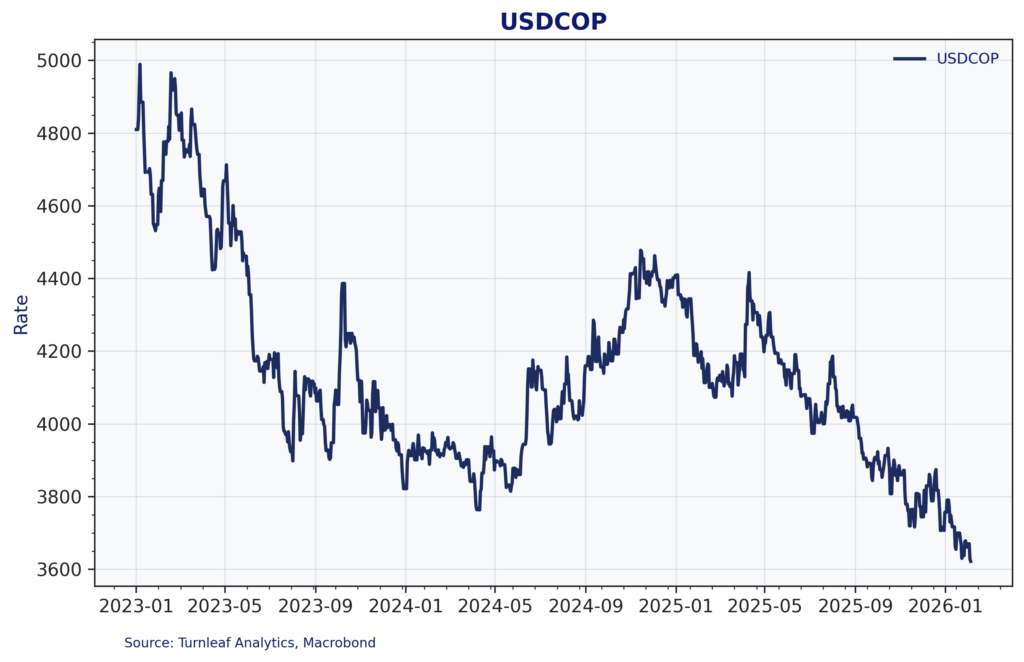 The price shock of a minimum wage increase of this magnitude is likely to push prices higher across broad segments of the economy, particularly in labor-intensive service sectors. The combination of strong indexation pressures, staggered adjustment timing throughout the year, and elevated inflation expectations creates a challenging environment for monetary policy. Turnleaf will keep updating its inflation forecasts as new data comes in, including developments that could signal higher-for-longer interest rates.